Buenos Aires and Rosario Emerge as Key Gateways for a New Wave of European Retail Brands in Argentina
Argentina is returning to the expansion plans of major international fashion and retail groups. Buenos Aires is concentrating the first flagship openings, while Rosario is emerging as one of the priority cities for the next stage of expansion, with confirmed projects and additional brands considering the market.

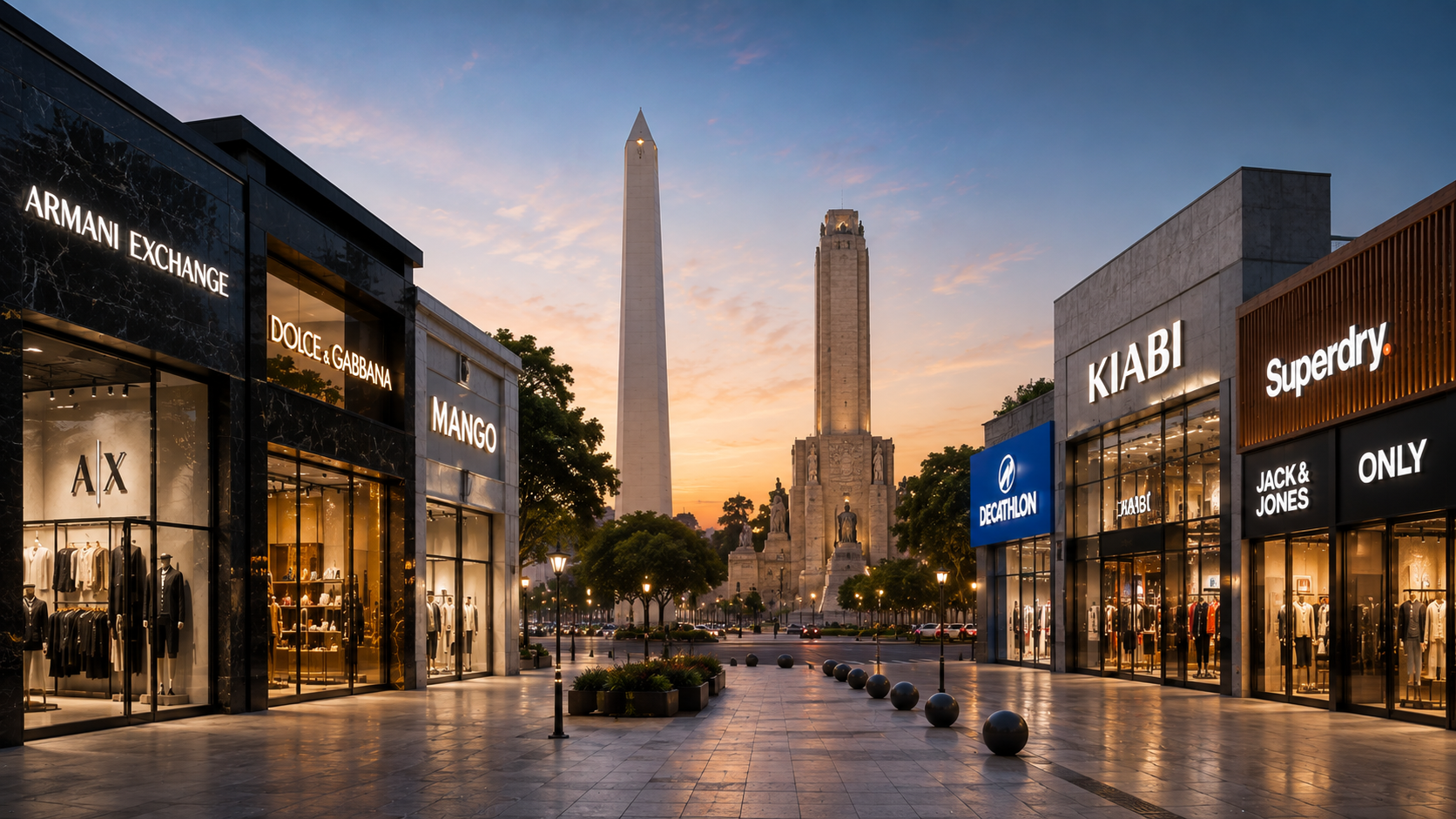
After years in which currency controls, import restrictions and economic volatility discouraged the arrival of global retailers, Argentina is once again appearing on the expansion maps of international fashion groups.
The second half of 2026 is bringing a series of openings spanning luxury, fast fashion and premium casualwear. But behind the individual announcements lies a broader geographical pattern: Buenos Aires is serving as the principal entry point, while Rosario is positioning itself as one of the most attractive locations for brands looking beyond the capital.
The change is particularly relevant from a European business perspective. A significant proportion of the brands involved originate in Europe, and several are returning after years of absence or entering Argentina for the first time.
Buenos Aires becomes the launchpad
Argentina's capital and its metropolitan area remain the obvious starting point for most international retailers.
The concentration of consumers, premium shopping centres, tourism and established commercial corridors makes Buenos Aires the preferred market for testing a brand before committing to a wider national rollout.
That is already visible across several of the projects scheduled for the second half of the year.
Armani Exchange, part of Italy's Armani group, is preparing its return to Argentina through a first store at Unicenter, operated by Grupo Tucci. The opening is planned for the second half of August, with Emporio Armani expected to follow in 2027. Armani had withdrawn from Argentina in 2009.
The Italian luxury sector has already begun moving. Dolce & Gabbana opened its first Argentine boutique at Patio Bullrich, occupying approximately 216 square metres. The shopping centre has also added other European names including Spain's Adolfo Domínguez, Germany's Montblanc and Italy's Paul & Shark.
The message is increasingly clear: international retailers once again see premium locations in Buenos Aires as viable gateways into the Argentine market.
Mango returns after more than two decades
One of the most significant European comebacks will be that of Mango.
The Spanish fashion group is preparing to reopen in Argentina after an absence of more than two decades. Its first store will occupy around 700 square metres at Alto Palermo, with an opening expected in September and an e-commerce platform accompanying the physical launch.
Argentine footwear and fashion company Grimoldi will operate the business locally.
The first Buenos Aires store will effectively serve as a test for the broader rollout. Grimoldi's plan contemplates approximately €2.5 million-equivalent annual investment at current dollar-denominated planning levels and five stores over five years, with Rosario explicitly identified among the potential strategic locations for future expansion.
That makes Mango an important example of the emerging two-stage strategy: establish the brand in Buenos Aires and subsequently move into Argentina's largest regional consumer markets.
Kiabi goes one step further: Buenos Aires first, Rosario next
The clearest evidence of Rosario's growing importance comes from Kiabi.
The French affordable-fashion retailer will make its Argentine debut at Florida 313 in downtown Buenos Aires, where it plans a store of approximately 1,500 square metres.
But unlike brands that have not yet defined their expansion beyond the capital, Kiabi has already selected its next major destination.
The company will open a 1,200-square-metre store at Portal Rosario before the end of 2026, making Rosario its first location in Argentina outside Buenos Aires.
The significance goes beyond a single opening. Rosario is effectively being used as an early test of whether a European mass-market fashion concept can be replicated successfully outside the Buenos Aires metropolitan area.
Kiabi's Argentine development is being managed by Grupo One, linked to businessman Manuel Antelo and Sabine Mulliez, a member of the family behind French retailer Decathlon.
Rosario builds its own international retail cluster
Kiabi will not arrive in isolation.
Portal Rosario is undergoing a substantial repositioning that is bringing several international retailers into the city. The shopping centre has announced Kiabi, Indian, Balmohk, Only and Jack & Jones, which together will occupy close to 4,000 square metres. The project follows the previously announced arrival of Decathlon.
Two of those fashion names add further European weight to the city's transformation: Only and Jack & Jones belong to Denmark's Bestseller group.
Meanwhile, Decathlon is French, meaning Rosario is becoming a direct destination for several European retail concepts rather than merely receiving brands years after their Buenos Aires launches.
For international groups assessing Argentina, the city offers a large metropolitan consumer base and serves as the commercial centre of one of the country's most economically important agricultural and industrial regions.
Superdry chooses Argentina for a regional role
British fashion company Superdry represents a different type of investment.
Rather than treating Argentina simply as another national retail market, the company intends to use the country as part of the restructuring of its South American presence.
Together with Argentine partner Tango Fabric, Superdry plans to invest between $40 million and $50 million over four years. Its strategy includes a flagship store in Buenos Aires, scheduled for August.
The location is expected to have a dual function: retail outlet and regional headquarters for South America.
This gives the investment a significance beyond store openings. Argentina would become a decision-making platform for Superdry's regional operations, demonstrating that some European groups see the country not only as a consumer market but potentially as an operational base for the wider Southern Cone.
H&M prepares another major European arrival
The internationalisation of Argentine retail is expected to continue into 2027.
Swedish fashion giant H&M has confirmed plans to enter Argentina, with its first store expected at Alto Palermo in Buenos Aires. The operation will be developed through Panamanian franchise partner Hola Moda.
The arrival will substantially increase competition in mass-market fashion, particularly as Mango and Kiabi establish their own physical networks.
For Argentina, H&M's entry is also symbolically important. The Swedish company has operated elsewhere in Latin America since entering Mexico in 2012, but Argentina remained outside its regional footprint amid the country's economic and regulatory instability.
Its decision to enter now reinforces the perception among international retailers that market conditions have changed sufficiently to justify establishing an early position.
Which of the incoming brands are European?
European companies account for a substantial share of the current wave of retail expansion:
Armani — Italy
Dolce & Gabbana — Italy
Mango — Spain
Kiabi — France
Superdry — United Kingdom
H&M — Sweden
Decathlon — France
Only and Jack & Jones / Bestseller — Denmark
Adolfo Domínguez — Spain
Montblanc — Germany
Paul & Shark — Italy
The principal non-European name highlighted in the original wave of announcements is Lucky Brand, the denim company founded in Los Angeles, United States.
Lucky Brand brings the US into the expansion race
Lucky Brand plans to establish its first physical store at DOT Baires Shopping, backed by an initial investment of approximately $1 million and operated locally by Oxford.
Its ambitions are considerably larger than a single location: the company is targeting a network of as many as 30 exclusive stores.
Rosario could eventually form part of that expansion. The brand's local partners have held discussions with major shopping-centre operators, including groups with assets in the city, opening the possibility of a future Rosario location. At this stage, however, unlike Kiabi, a Rosario store has not been confirmed.
That distinction is important: Rosario is clearly entering retailers' expansion calculations, but not every potential opening has yet become a firm commitment.
Why are international brands returning now?
The resurgence is taking place despite an Argentine consumer market that remains challenging.
International groups are looking beyond current sales conditions toward changes in the broader operating environment. Greater macroeconomic stability, easing restrictions on imports and foreign-exchange movements, and the possibility of offering products at prices closer to international benchmarks have improved the investment equation.
For global brands, timing also matters.
Entering while commercial locations and operating costs remain relatively attractive can allow retailers to secure strategic positions before a stronger consumption recovery potentially raises the cost of expansion.
Argentina additionally represents a market of more than 40 million consumers that has historically been underserved by several of the world's largest fashion chains.
The other side: pressure on Argentina's textile industry
The international retail boom has another side.
Greater access to imported clothing and the arrival of global competitors are increasing pressure on domestic manufacturers already facing weak demand.
Argentina's textile sector has warned about the effects of rapidly rising imports and falling local production. Clothing and household-textile imports increased sharply during 2025, while domestic textile activity has experienced substantial contraction.
The policy shift therefore creates a contrasting picture: more choice and potentially greater price competition for consumers, but significantly tougher conditions for local producers.
That tension is likely to become one of the central economic debates surrounding the internationalisation of Argentine retail.
Buenos Aires opens the door, but Rosario is moving onto the shortlist
The most important development may ultimately be geographical.
For decades, the arrival of an international brand in Argentina often meant little more than opening a flagship store in Buenos Aires. The current wave suggests a broader model is emerging.
Buenos Aires remains the country's principal showcase and the preferred location for first flagship stores, with Armani Exchange, Mango, Kiabi, Lucky Brand, Superdry and eventually H&M using the metropolitan market as their initial platform.
But Rosario is increasingly becoming the natural second step.
Kiabi has already confirmed its first interior store there. Mango has identified Rosario as a potential expansion market. Lucky Brand's national rollout creates the possibility of a future presence, while shopping center Portal Rosario is simultaneously bringing in Decathlon, Only and Jack & Jones.
For European retailers, the Argentine opportunity may therefore be evolving from a single-city strategy into a broader national proposition.
And if the first wave performs as expected, Buenos Aires and Rosario could emerge as the two principal gateways for the next generation of European retail investment in Argentina.