Europe and Latin America’s investment corridor: where capital is moving and what still holds it back
Energy, mining, manufacturing and digital services are drawing European companies into Latin America, while Latin American businesses are building a presence in Europe. The opportunity depends on more than access to markets: infrastructure, financing and regulatory execution will determine which projects become operating businesses.

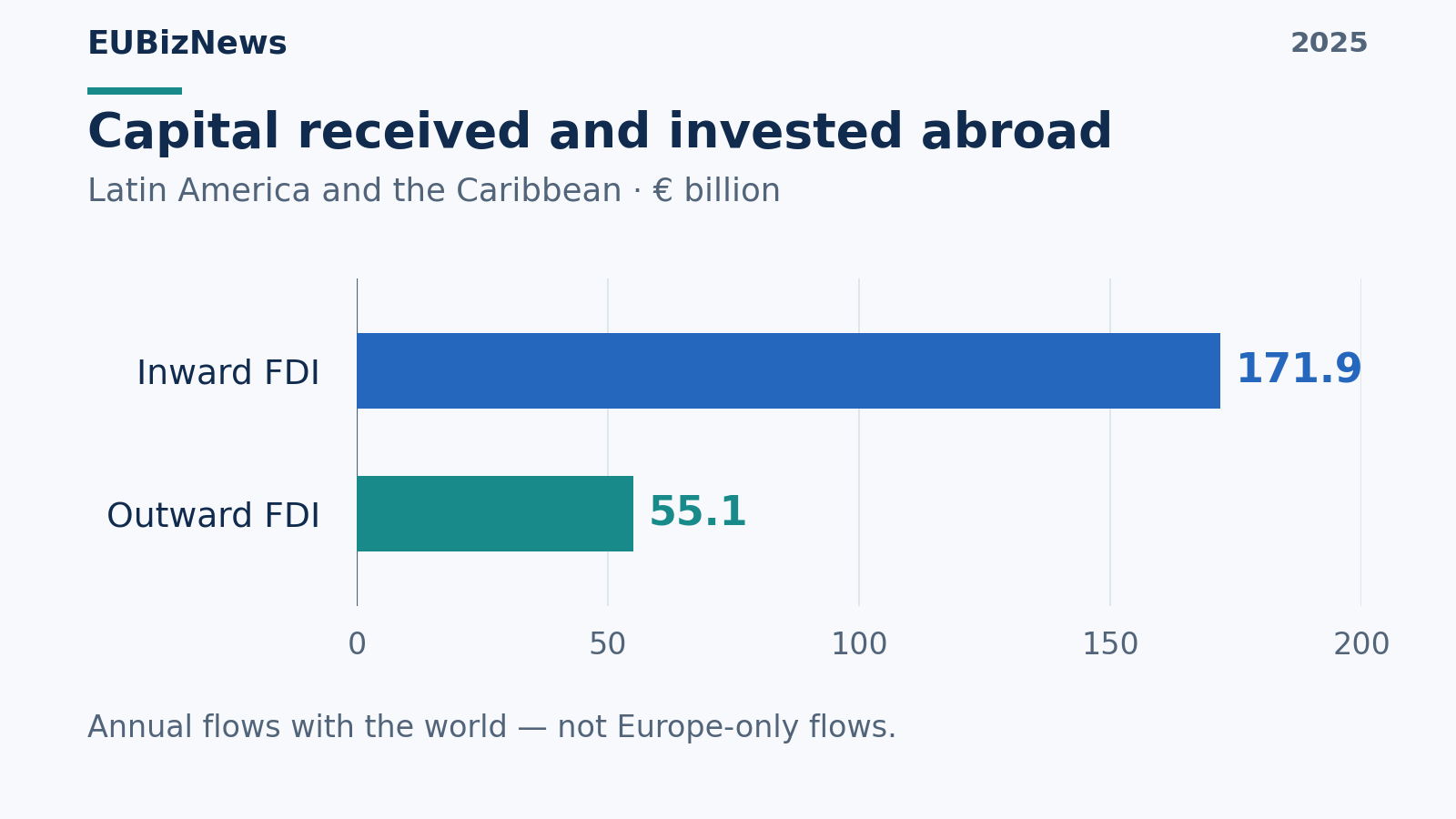
Europe supplied 32% of the foreign direct investment with an identifiable origin entering Latin America and the Caribbean in 2025. Yet total regional inflows rose only 1.7%, to approximately €171.9 billion. The contrast matters: Europe remains a major investor in a market where investment is advancing unevenly, rather than through a broad-based expansion.
For European companies, the region offers several distinct routes to growth. Brazil provides industrial scale and a large domestic market. Mexico connects manufacturing operations with North American supply chains. The mineral and energy resources of the Southern Cone and the Andean economies support another investment agenda, while Costa Rica illustrates the role that specialised manufacturing can play in a smaller economy.
The relationship also runs in the opposite direction. Latin American groups use European operations to acquire customers, technology and management capabilities, diversify revenues and build businesses outside their home markets. Spain, Portugal and the United Kingdom serve different functions within that process; they should not be treated as interchangeable gateways.
The central question is no longer simply where capital wants to go, but what allows it to stay, expand and generate returns. A signed acquisition, an announced factory and an operating plant describe different stages of investment. Combining them into a single narrative of growth can obscure both the opportunity and the risks.
The numbers require a more selective reading
Regional indicator | 2025 result |
|---|
Brazil and Mexico: combined share of inward FDI | 62% |
Reinvested earnings: share of inward FDI | 51% |
New project announcements: change in value | −34.3% |
Outward FDI from Latin America and the Caribbean | Approximately €55.1 billion |
These indicators measure different concepts and must not be added together. Reinvestment is economically significant: an existing investor may finance a production line, introduce a new service or strengthen a subsidiary. But retained earnings are not, by themselves, evidence that a new company has entered the market or that the full amount has been spent on fixed assets. Equally, an acquisition changes ownership; any subsequent expenditure on capacity, employment or technology is a separate decision.
Trade agreements open routes, not automatic returns
The EU–Mercosur interim Trade Agreement has applied provisionally since 1 May 2026, following its signature in January. It covers the EU’s relationship with Argentina, Brazil, Paraguay and Uruguay. The broader Partnership Agreement follows a separate ratification process: provisional application of the trade instrument should not be confused with full entry into force of the entire partnership.
The commercial implications reach beyond finished goods. A change in the cost of importing machinery or components can alter the economics of local production, maintenance and distribution. European suppliers may also find opportunities to serve investment by Latin American companies, without necessarily acquiring a business or building a factory themselves.
However, tariff concessions have schedules, product-specific conditions and rules of origin. The agreement does not remove every barrier at once, nor does it replace national authorisations, environmental requirements or the infrastructure needed to bring a product to market.
Chile and Mexico illustrate the need to examine each trade relationship separately. The EU–Chile interim Trade Agreement entered into force on 1 February 2025. The EU and Mexico signed their modernised Global Agreement and an interim Trade Agreement on 22 May 2026, but signature should not be presented as implementation: the existing agreement continues to govern trade pending the relevant ratification and entry-into-force steps.
For European companies, there is no single Latin American market-access framework. Production location, input origin and the intended customer market remain central to investment decisions.
Scale, specialisation and the operating constraints
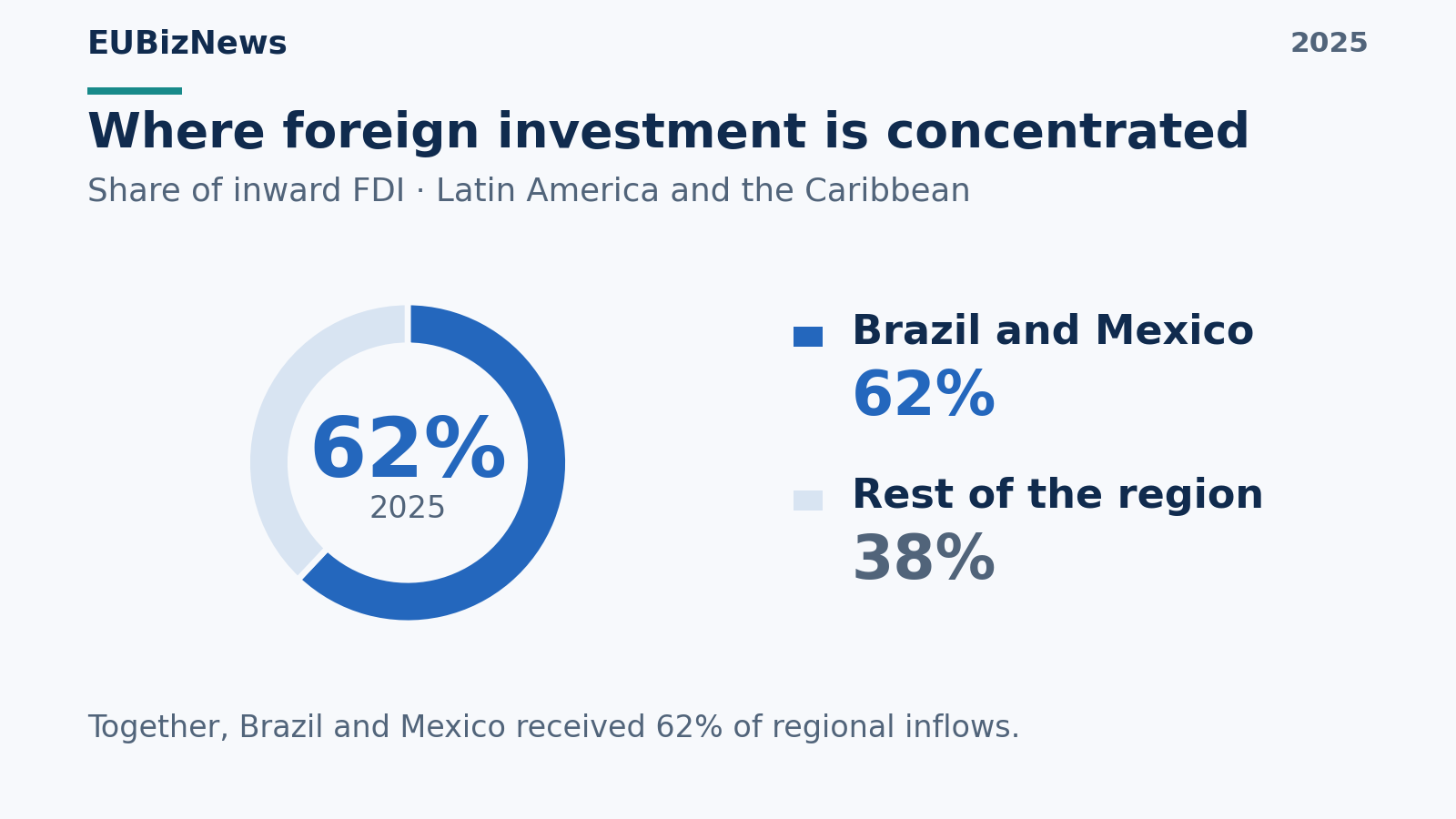
Brazil and Mexico offer scale, but for different reasons. Brazil combines domestic demand with opportunities across agribusiness, energy, industrial production, infrastructure and digital services. An acquisition can provide an established customer base and an operating platform, although the business case still depends on integration, financing costs and the ability to manage tax and regulatory complexity.
In Mexico, proximity to the United States and an established manufacturing base make the country relevant to supply-chain relocation. But nearshoring—the placement of operations closer to their final market—is not a substitute for a viable operating plan. Access to reliable electricity, water, transport and specialised workers can decide whether a proposed site is usable. Exposure to North American trade policy adds another variable to cost and location decisions.
For Argentina, Chile and Peru, natural resources connect investment in extraction with a wider demand for engineering, energy, transport, equipment and services. The European opportunity is not limited to owning a mine or an oilfield. It can also involve supplying the technology and infrastructure that allow an existing asset to produce more efficiently or reach export markets.
Argentina’s RIGI provides tax, customs and foreign-exchange incentives for qualifying large investments. Eligibility and approval matter, but incentives alone cannot supply infrastructure or complete environmental processes. For developments linked to Vaca Muerta, lithium and copper, connecting the producing asset with its route to market remains decisive.
Chile’s data-centre strategy demonstrates how this agenda extends beyond commodities. Digital infrastructure depends on power availability, connectivity and sustainable operation. A proposed data centre and a renewable-energy development may therefore share a commercial constraint: neither creates value merely because the resource or market demand exists; both require infrastructure and customers that support the investment.
Costa Rica provides a different reference point. Official figures put 2025 FDI at approximately €4.53 billion, with 66.4% of inflows associated with the free-trade-zone regime. Manufacturing growth was driven by reinvestment in medical-device companies. The lesson for smaller markets is not that scale is irrelevant, but that specialised capabilities and an established supplier and workforce base can support repeated investment.
Eight markets, eight distinct investment tests
The following comparison identifies opportunities and execution requirements. It is not a ranking of returns or an investment recommendation.
Market | Areas of opportunity | Key execution test |
|---|
Brazil | Industry, agribusiness, energy, infrastructure and digital services | Integrating operations while managing financing, tax and regulatory complexity |
Mexico | Manufacturing, industrial supply chains, logistics and payments | Securing utilities, talent and market access amid trade-policy uncertainty |
Argentina | Oil and gas, lithium, copper, infrastructure and technology | Turning eligible projects into financed assets with viable export routes |
Chile | Copper, lithium, renewables and digital infrastructure | Coordinating permits, power, connectivity and long-term commercial demand |
Peru | Mining, construction materials and infrastructure | Connecting investment schedules with permits, local conditions and project delivery |
Colombia | Financial services, telecommunications, energy and business services | Assessing regulatory continuity, sector economics and financing conditions |
Costa Rica | Medical devices, specialised manufacturing and business services | Expanding talent and supplier capacity alongside established investors |
Venezuela | Energy and selective rehabilitation of existing assets | Verifying sanctions permissions, counterparties, payment channels and operational feasibility |
In Colombia, telecommunications, financial services and energy face different regulators and funding requirements. The investment case needs to reflect sector economics, not only the political calendar.
Venezuela requires a separate risk assessment. OFAC licences authorise defined activities; they do not amount to a blanket removal of sanctions. The applicable permission, counterparties, payment arrangements and conditions must be checked for each transaction. The possibility of rehabilitating an underused asset should therefore not be confused with unrestricted access to financing or an assured route to repatriating proceeds.
Corporate transactions show what investors are buying
Two completed acquisitions illustrate the diversity of European interest. Holcim completed its purchase of a majority stake in Peru’s Cementos Pacasmayo on 30 March 2026. The transaction adds an operating production and distribution business to the Swiss group’s regional presence. It is an example of expansion through an established industrial platform, rather than a new plant announcement.
Heineken completed the acquisition of FIFCO’s beverage and retail businesses on 30 January 2026, strengthening its position in Central America. The target perimeter comprises those businesses, not the whole of FIFCO. This is a different growth strategy: acquiring brands, distribution and consumer-market exposure through an existing operation.
Europe is also a destination for Latin American capital
Spain’s role is supported by an existing corporate base. ICEX’s Global LATAM 2025 publication reported accumulated Latin American investment of approximately €47.3 billion excluding foreign-securities holding entities, or €66.8 billion including them. These are stock measures reported in that edition, not investment received during 2025. The difference also shows why holding-company positions should not be equated automatically with productive expenditure inside Spain.
Spain, Portugal and London offer different business functions. Spain combines corporate networks and a Spanish-language operating environment within the EU. Portugal has a particular connection with Brazilian business through language and longstanding commercial links. London provides a platform for capital raising and international transaction services, although the United Kingdom is outside the EU single market.
The next phase will be measured after the announcement
The region’s investment pipeline faces three practical tests: financing the complete plan, securing approvals and infrastructure, and generating revenue on the terms assumed in the business case.
Transaction design can distribute uncertainty, but it cannot make it disappear. Staged investments, joint ventures and payments linked to future performance can help align the parties. They can also create disputes over control, accounting and milestones if the commercial assumptions are not clear. The contract and the operating plan therefore need to be assessed together.
For governments, the challenge extends beyond announcing incentives. Consistent administrative processes, infrastructure delivery and workforce development influence whether an investor expands an existing operation or chooses another location. For European businesses, the corresponding task is to distinguish a market’s underlying potential from the specific project that can be delivered there.
The opportunity between Europe and Latin America is substantial, but it is not uniform. Its lasting value will be measured in operating capacity, supplier development, technology and access to customers—not simply in the number or size of announced deals. The strongest investment strategies will be those that connect financial commitments with the conditions required to turn them into functioning businesses.