Europe’s Most Valuable Companies by Country: ASML Leads a Continent of Corporate Champions
From semiconductors and pharmaceuticals to banking, industrial technology and consumer brands, Europe’s largest listed companies reveal a diversified economic power base—and the challenge of turning national strengths into global scale.

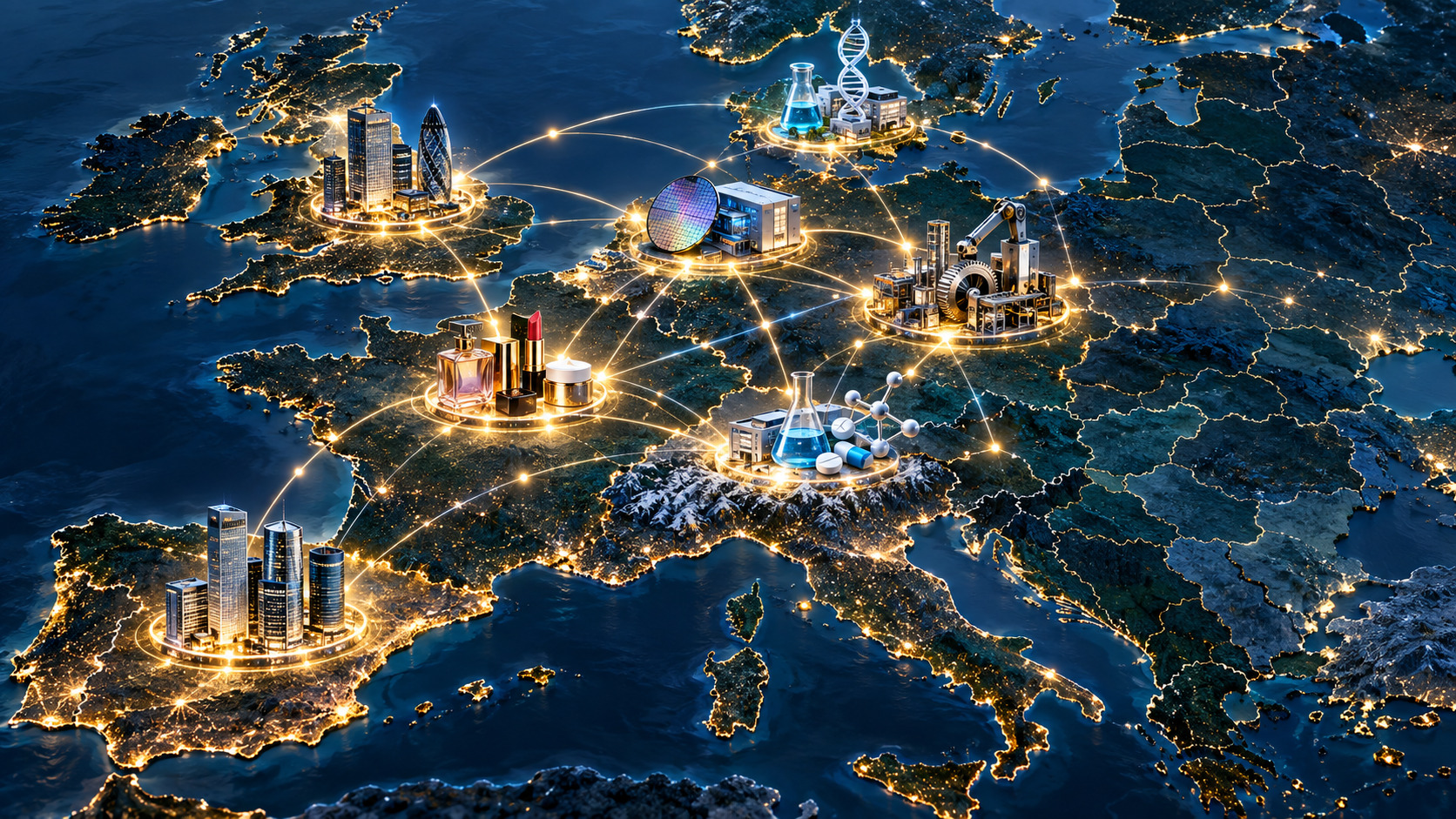
Europe is often analysed as a single economic bloc, but its corporate landscape remains deeply national. A map of the continent’s most valuable publicly traded companies shows how decades of industrial policy, scientific research, capital formation and brand development have produced different centres of corporate power.
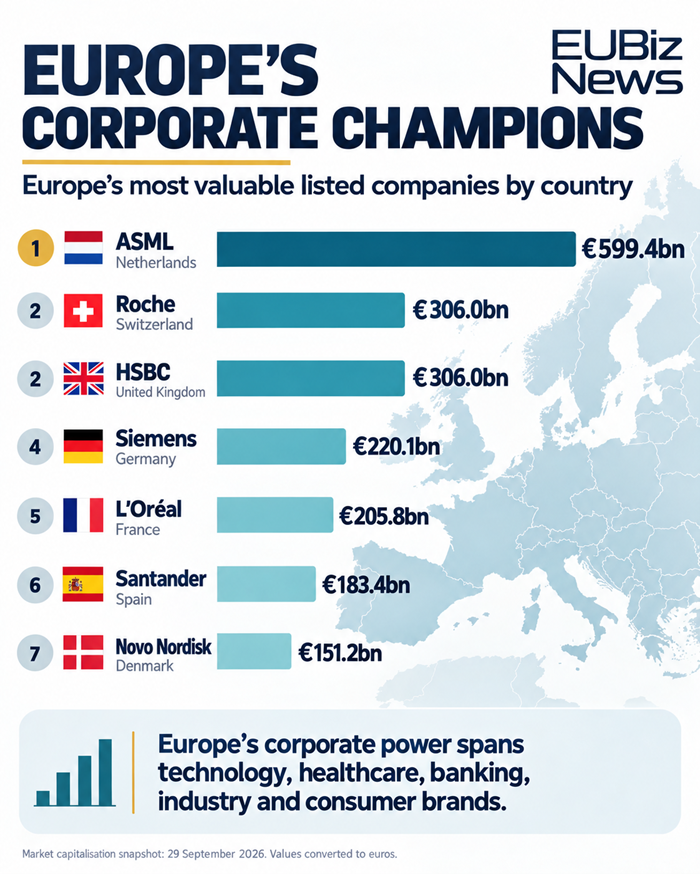
At the top stands ASML, the Netherlands-based semiconductor-equipment group, with a market capitalisation of approximately €599.4 billion. Its commanding position reflects more than investor enthusiasm for artificial intelligence and advanced computing: the company is the world’s only supplier of extreme ultraviolet lithography systems required to manufacture the most sophisticated chips.
That technological position has made ASML a strategic asset not only for the Netherlands, but for Europe as a whole. Its equipment sits at a critical point in global semiconductor supply chains, giving the continent influence in an industry otherwise dominated by chip designers and manufacturers in the United States and Asia.
The ranking, based on market values recorded on 29 September 2026, identifies the largest listed company headquartered in each European country. Dollar valuations have been converted into euros at the prevailing exchange rate, and therefore remain subject to market and currency fluctuations.
Healthcare, finance and industry shape Europe’s corporate hierarchy
Behind ASML, the map becomes more diverse.
Switzerland’s Roche and the United Kingdom’s HSBC were each valued at approximately €306 billion, although they represent markedly different forms of economic power.
Roche embodies Switzerland’s concentration of pharmaceutical, biotechnology and life-sciences expertise. HSBC, meanwhile, reflects London’s continuing importance as an international banking and capital-markets centre, connecting Europe with Asia, the Americas and the Middle East.
Germany’s leading company, Siemens, carried a market value of approximately €220.1 billion. Its position captures the country’s traditional strengths in engineering, electrification, industrial automation, transport and infrastructure—sectors that will remain central to Europe’s energy and digital transitions.
In France, L’Oréal reached approximately €205.8 billion, demonstrating the value generated by intellectual property, research, premium positioning and global distribution in the consumer sector. The cosmetics group overtook LVMH as France’s most valuable listed company in 2026, illustrating how consumer demand and changing economic conditions can quickly reorder national corporate rankings.
Spain’s Santander, valued at around €183.4 billion, highlights the international reach of European banking. Its extensive operations in continental Europe, the United Kingdom and Latin America make the group one of the clearest corporate bridges between the two regions.
Denmark’s Novo Nordisk, at approximately €151.2 billion, shows how a relatively small national economy can produce a global leader through scientific specialisation. Its valuation has undergone a significant correction from previous highs, but the company remains central to the global market for diabetes and obesity treatments.
Other national champions reinforce the sectoral variety. Ireland’s Eaton was valued at approximately €150.3 billion, Belgium’s AB InBev at €130.6 billion, Italy’s UniCredit at €127.9 billion, Sweden’s Investor AB at €110.9 billion and Norway’s Equinor at around €90.4 billion.
Together, they span electrical systems, brewing, banking, industrial investment and energy.
Banks dominate many smaller markets
One of the map’s most revealing patterns appears beyond Western Europe’s largest economies.
Banks are the most valuable listed companies in 15 of the 42 countries included. Financial institutions dominate several markets in Central, Eastern and Southeastern Europe, where banking groups often have broader capital-market visibility than industrial or technology businesses.
The list includes Russia’s Sberbank, Finland’s Nordea, Austria’s Erste Group, Hungary’s OTP Bank, Greece’s Eurobank, Croatia’s Zagrebačka banka, Belarusbank and financial institutions in Bosnia and Herzegovina, North Macedonia, Moldova and Liechtenstein.
This concentration points to the differing depth of European capital markets. Some countries have produced listed companies with global reach and valuations above €100 billion. Others remain represented by financial, utility or energy groups worth only a small fraction of that amount.
Market capitalisation does not provide a complete measurement of an economy’s productive capacity. It excludes privately held businesses, state-owned groups that are not listed and foreign companies with substantial local operations. It also reflects investor expectations rather than revenue, employment or industrial output.
Even so, it shows where public markets currently assign value and which companies possess the strongest capacity to raise capital, make acquisitions and finance international expansion.
Diversity is an advantage—but fragmentation remains a weakness
Europe differs from the United States, where a relatively small group of technology platforms accounts for a large share of total stock-market value.
Its corporate strength is distributed across semiconductors, pharmaceuticals, banking, industrial equipment, energy, telecommunications, consumer products and natural resources. This diversification can provide greater resilience when individual industries experience downturns.
It also gives Europe strategic capabilities that extend beyond digital platforms. The continent possesses advanced manufacturing knowledge, internationally recognised brands, sophisticated financial institutions and research networks capable of producing globally relevant technologies.
But the map also exposes a scale problem.
Many European companies remain primarily national or regional leaders, while fragmented capital markets, regulatory differences and obstacles to cross-border consolidation can limit their ability to compete with larger American and Asian groups.
The central question for European competitiveness is therefore not simply whether the continent can create more companies. It is whether its strongest businesses can invest, innovate, consolidate and expand quickly enough to remain globally influential.
ASML demonstrates what is possible when specialised European knowledge becomes indispensable to an international industry. Roche and Novo Nordisk show the value of sustained scientific investment. Siemens reflects the durability of industrial expertise, while L’Oréal demonstrates how innovation and branding can turn consumer products into global platforms.
Europe already has corporate champions. Its next challenge is to build the financial, regulatory and technological environment that allows more of them to reach comparable scale.
Market capitalisation is not merely a ranking of investor valuations. In an era of strategic competition, it increasingly indicates access to capital, technological relevance and the ability to influence global supply chains.