Germany and Brazil Aim to Double Trade as Hannover Messe Becomes a Platform for Industrial Realignment
Berlin and Brasília want to sharply expand bilateral trade, using Hannover Messe to deepen cooperation in digital industry, raw materials and renewable energy at a time when the EU–Mercosur deal is moving closer to provisional application.

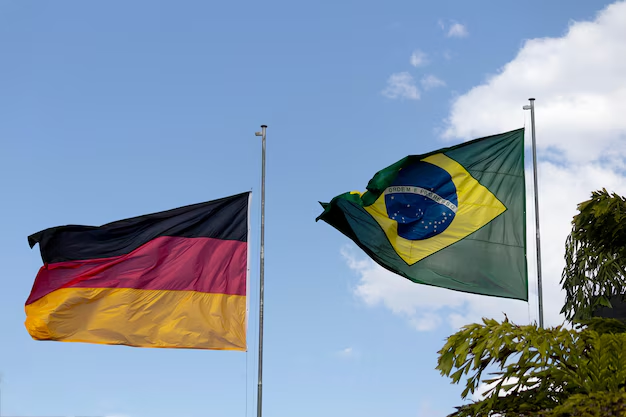
Germany and Brazil are using Hannover Messe 2026 to push for a new phase in their economic relationship, with Chancellor Friedrich Merz saying both countries aim to double bilateral trade in the coming years. Speaking at the Germany-Brazil Economic Meeting held alongside the industrial fair, Merz described Brazil as a key partner for Germany in a more fragmented global economy.
The ambition starts from an already significant base. According to Merz, bilateral trade between the two countries exceeded €20 billion in 2024, but he argued that figure remains below the potential of Europe’s and Latin America’s largest economies. He linked the push for stronger trade flows to the EU–Mercosur agreement, which he said is due to enter provisional force on May 1.
The relevance is broader than one bilateral relationship. Germany is effectively framing Brazil as a strategic industrial partner for Europe in three areas: digital transformation and Industry 4.0, rare earths and raw materials, and renewable energy. Those priorities align closely with the sectors Europe is trying to strengthen as it reduces external dependencies and rebuilds industrial competitiveness.
Merz also underscored the industrial depth of the relationship already in place. Around 1,300 German-owned companies operate in Brazil, including Siemens, Bayer, Volkswagen, BASF and Mercedes-Benz, and together they account for about 10% of Brazil’s industrial value added, according to his remarks. Germany remains a major market for Brazilian raw materials and agricultural products, while Brazil is an important destination for German machinery, chemicals and vehicles.
That makes Hannover Messe more than a symbolic setting. With Brazil appearing as the guest nation, the fair is functioning as a platform to reposition the Europe–Latin America business corridor around industrial cooperation rather than only commodity trade. In practical terms, Germany is signaling interest not just in selling into Brazil, but in building longer-term partnerships around smart manufacturing, critical minerals and energy transition technologies. This last point is an inference based on the cooperation areas explicitly highlighted by Merz.
Brazilian President Luiz Inácio Lula da Silva used the same stage to highlight the resilience of Brazil’s economy, saying GDP growth had averaged more than 3% over the previous three years despite a difficult global backdrop. That argument reinforces Brasília’s attempt to present the country as both a demand market and a strategic production base for European investors.
For Europe, the message is clear: Brazil is being treated as a central partner in the bloc’s wider Latin America strategy. For Latin America, the moment suggests that industrial cooperation with Europe is moving beyond diplomacy into a more concrete investment and trade agenda. If the bilateral target gains traction, Germany’s relationship with Brazil could become one of the clearest test cases for how Europe intends to scale its commercial presence in the region over the next decade. This final sentence is an inference based on the stated trade goal and the strategic sectors identified during the meeting.