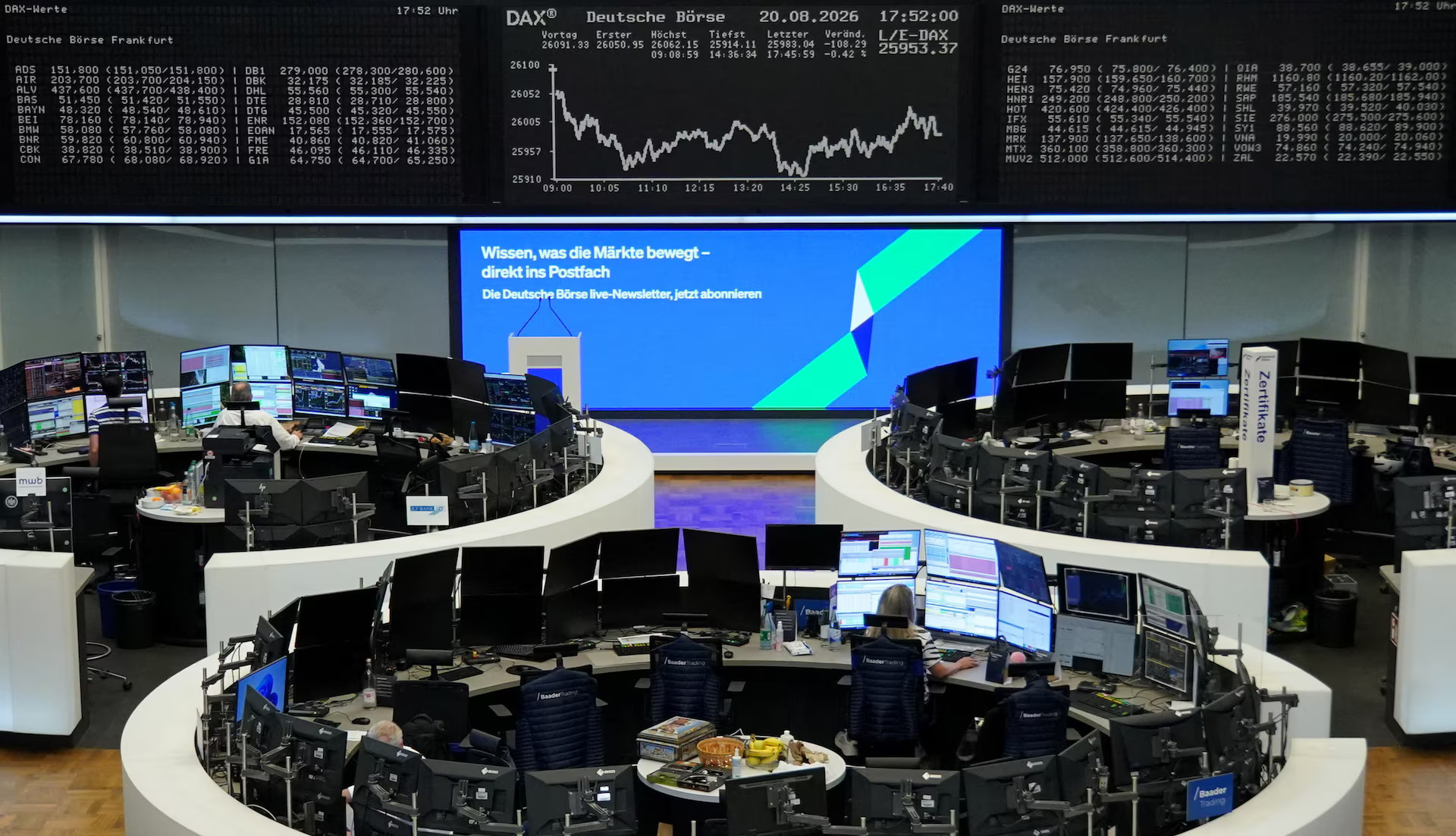
ECB Decision and PMI Data Set the Tone for Global Markets Next Week
Investors will closely monitor next week’s preliminary business activity data from the eurozone, the United States and the United Kingdom, alongside the European Central Bank’s latest monetary policy meeting. The combination of PMI indicators, interest-rate guidance and persistent geopolitical uncertainty is expected to shape market expectations for economic growth and central bank policy during the second half of the year.


Financial markets are entering one of the most important weeks of the summer as investors assess whether the global economy continues to show resilience despite higher energy prices and geopolitical tensions.
Attention will center on the European Central Bank’s monetary policy decision and the release of preliminary Purchasing Managers’ Index (PMI) surveys for the eurozone, the United States and the United Kingdom, widely regarded as one of the earliest indicators of business activity each month.
While economists broadly expect the ECB to keep interest rates unchanged, markets will closely examine President Christine Lagarde’s comments for signals on the outlook for inflation and whether another rate increase could still be considered later this year.
PMIs to offer the first snapshot of July’s economy
The PMI surveys will provide investors with an early reading of conditions across the manufacturing and services sectors.
The figures are expected to show whether businesses have maintained momentum despite renewed pressure from higher energy costs linked to tensions in the Middle East. Manufacturing activity has shown signs of stabilization in recent months, while services continue to support economic growth across many advanced economies.
Any unexpected slowdown could reinforce concerns about weaker global demand, while stronger-than-anticipated results would support expectations that the world’s major economies remain on track for a gradual expansion.
ECB guidance remains crucial for investors
Although no policy change is anticipated, the ECB meeting could prove decisive for financial markets.
Inflation has moderated across much of the eurozone, but elevated energy prices and geopolitical uncertainty continue to complicate the central bank’s outlook. Investors will therefore focus on whether policymakers maintain a cautious stance or indicate that borrowing costs may need to remain higher for longer.
The ECB’s communication will also influence government bond markets, the euro and broader investor sentiment across Europe.
Global markets weigh multiple risks
Beyond Europe, markets will also digest a series of economic indicators from the United States and Asia, including housing data, inflation releases and central bank decisions.
Meanwhile, developments in the Middle East remain an important source of uncertainty after recent disruptions pushed oil prices higher, raising fresh questions about inflation and global supply chains.
For multinational companies and investors, the coming week could provide valuable insight into whether economic activity is proving resilient enough to withstand a more challenging geopolitical environment.
Why it matters for Europe and Latin America
The outcome of the ECB meeting and the latest business surveys will be closely watched beyond Europe.
Interest-rate expectations in the eurozone influence global capital flows, financing costs and investor appetite for emerging markets, including Latin America. A stable European economy could support trade, foreign direct investment and corporate financing across the region, while signs of slowing growth may affect demand for exports and international investment.
With monetary policy, inflation and geopolitical developments converging, next week’s economic calendar is expected to set the tone for financial markets well into the second half of the year.