Europe could add 148 GW of wind by 2030, but grid access is emerging as the next investment bottleneck
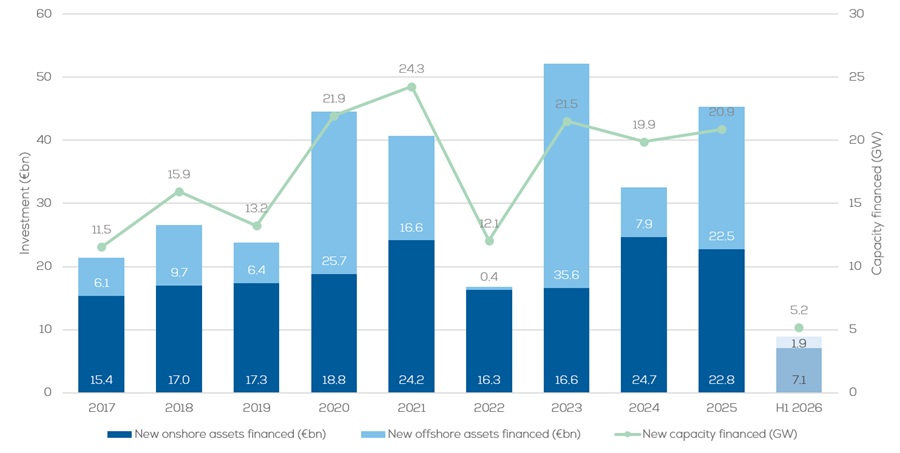
WindEurope expects €17.3 billion invested in new wind projects through September 2026 to finance 9.8 GW of capacity. Guy Brindley, Head of Market Intelligence at WindEurope, tells EUBizNews that investor appetite and supply-chain capabilities remain strong, while grids, permitting and auction design increasingly determine whether projects move from financing to construction.

Europe is heading towards another major expansion cycle for wind energy, with 148 GW of new capacity expected to be installed between 2026 and 2030, but the industry's central investment challenge is increasingly shifting away from access to capital and towards the infrastructure and regulatory conditions required to deliver projects.
The European Union is expected to account for 111 GW of those additions, equivalent to an average of around 22 GW a year, according to WindEurope.
The investment pipeline also remains active. By the end of September 2026, €12.6 billion had been invested in new onshore wind projects and €4.7 billion in two offshore projects, financing a combined 9.8 GW of new capacity. Further final investment decisions are expected before the end of the year.
But for Guy Brindley, Head of Market Intelligence at WindEurope, the outlook increasingly depends on whether Europe can solve problems surrounding grid access, permitting and project design.
“Onshore and offshore wind face different obstacles, but grid access is increasingly the common constraint,” Brindley told EUBizNews.
Onshore remains the engine of European growth
Onshore wind is expected to account for the overwhelming majority of installations over the remainder of the decade.
Including the 6.5 GW installed during the first half of 2026, WindEurope expects Europe to add 115 GW of new onshore capacity between 2026 and 2030, representing roughly 77% of the 148 GW forecast for the continent.
Offshore wind is expected to contribute more than 33 GW during the same period, including 20 GW within the EU. That would lift total European offshore wind capacity to around 72 GW by 2030, of which 41 GW would be located in EU waters.
The financing dynamics of the two segments are markedly different.
Onshore investment tends to be distributed across a larger number of smaller projects, with shorter development and construction cycles and lower capital requirements. Offshore wind depends on fewer but significantly larger investment decisions, meaning annual financing volumes can change sharply depending on when individual projects reach financial close.
That distinction also affects visibility over the construction pipeline.
“Onshore projects generally move from financing to construction more quickly and are supported by a broader pipeline of smaller investments,” Brindley said. “Offshore decisions are fewer and larger, with longer lead times and greater exposure to auction design, financing conditions and grid readiness.”
Capital is available, but projects still need somewhere to connect
The industry’s bottlenecks are becoming more operational than financial.
For offshore projects, WindEurope sees auction execution and design as one of the most important issues. The European supply chain expanded in response to anticipated demand from markets such as the UK, Germany and Poland, but in some cases projects have struggled to advance because of weak auction economics, grid limitations or incomplete regulatory frameworks.
Germany’s negative-bidding approach, for example, contributed to projects with weaker economic fundamentals, while other European auctions faced delays because grid capacity or supporting frameworks were not ready.
Those challenges came on top of the inflation, higher interest rates and supply-chain shocks that followed the pandemic.
For onshore wind, constraints vary more significantly between markets, but slow permitting and increasingly scarce grid capacity remain recurring problems.
Electricity demand is simultaneously increasing as data centres, artificial intelligence infrastructure and industrial electrification add new pressure to European networks.
Countries including Denmark and Spain are therefore exploring or implementing mechanisms to prioritise access to limited grid capacity, while industrial users may increasingly turn to power purchase agreements and other procurement structures.
“With the notable exception of Germany, permitting remains a key barrier. And grid access has worsened,” Brindley said. “Supply-chain capability and investor appetite remain; the main challenge is restoring a viable and predictable business case.”
Why revenue certainty still matters
How projects earn money once operational also remains crucial to their financing.
WindEurope considers two-sided Contracts for Difference (CfDs) the strongest revenue model for large capital-intensive wind developments because they provide long-term visibility over revenues.
That certainty allows lenders to offer more favourable financing terms and potentially higher levels of debt, reducing the overall cost of capital.
Corporate power purchase agreements (PPAs) can offer similar long-term revenue visibility when backed by creditworthy buyers, although developers remain exposed to greater counterparty and contractual risk than under government-backed mechanisms.
Full exposure to wholesale electricity markets is more challenging.
Wind projects can generate strongly during periods when power prices are already low or even negative. That increases revenue volatility and can make debt financing more expensive or difficult to secure.
Brindley said the basic principle should be that risk sits with the party best able to manage it.
Developers should carry construction and operational risks, electricity buyers should manage demand and contractual risks under their control, while governments should provide stable market rules, predictable auction schedules and protection from systemic risks that individual projects cannot efficiently manage.

Supply-chain investment now needs orders
The question is no longer only whether Europe has enough manufacturing capacity, but whether its factories will receive a sufficiently predictable pipeline of orders.
Offshore wind foundations illustrate that shift.
Several years ago, Europe faced insufficient manufacturing capacity for the offshore expansion then expected, particularly as larger turbines required larger foundations. The industry reacted with around €1.4 billion in announced investments to expand existing facilities and develop new factories.
But some of the demand expected from the US has since disappeared, while European projects have also experienced delays.
That creates the risk of gaps in factory order books, leaving manufacturers with underused capacity while continuing to carry the fixed costs generated by major industrial investments.
WindEurope estimates that every €1 million invested in a new manufacturing facility can support around three to four direct jobs.
Greater certainty around future projects is therefore directly connected not only to renewable-energy deployment, but also to European industrial employment and the continent's ability to avoid greater dependence on imported components.
Poland shows what policy visibility can unlock
Poland provides one of the clearest examples of how policy certainty can move offshore wind projects from plans into construction.
Over roughly a decade, the country has gone from having no commercial offshore generation to building its first projects while developing a significant pipeline behind them.
A clearer regulatory framework, long-term revenue support and visibility over auction volumes were central to that development.
Poland’s first competitive offshore wind auction, held in December 2025, awarded support to three projects totalling 3.4 GW, with further auctions planned.
For Brindley, however, Europe’s next major policy decision must look beyond the current decade.
“One of the most important decisions Europe can take in the next 12 months is to agree a strong post-2030 framework for renewable energy, including a renewable energy target,” he said.
The current 2030 framework has given investors visibility over the scale of the European market. Extending that signal beyond the end of the decade, WindEurope argues, would allow developers, manufacturers, ports and other supply-chain players to make investment decisions with greater certainty.
The 148 GW expected through 2030 suggests Europe still has a substantial wind pipeline. The harder question is increasingly whether grids, permitting regimes and national auction programmes can move quickly enough to convert financed capacity into operating assets — and industrial investment into lasting European manufacturing capacity.