
European stocks rise as oil retreats and dollar reaches seven-week high after Fed hike
The STOXX 600 advanced 0.5% as investors absorbed the Federal Reserve’s first rate increase since 2023. Lower crude prices supported travel and automotive shares, while attention shifted to the Bank of England.

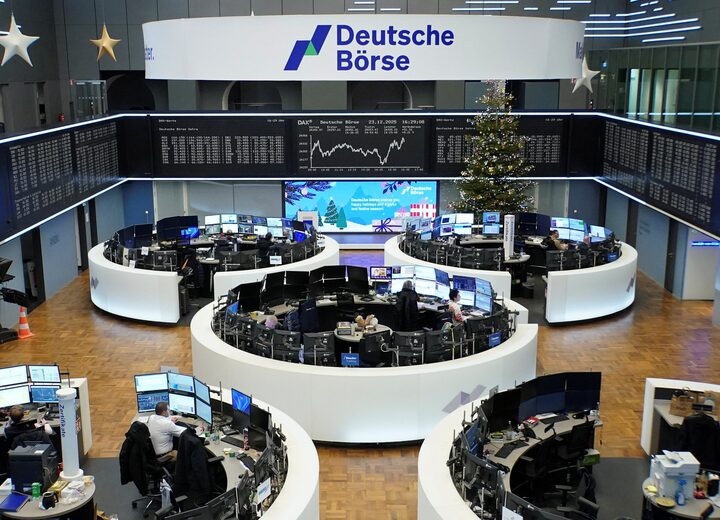
European equities opened higher on Thursday as investors responded to the Federal Reserve’s first interest-rate increase in more than three years, a stronger US dollar and a partial retreat in oil prices.
The pan-European STOXX 600 gained around 0.5%, recovering some of the losses accumulated during a period of rising energy prices, inflation concerns and pressure on government bonds.
Germany’s DAX rose approximately 0.6%, while France’s CAC 40 added 0.5%. The United Kingdom’s FTSE 100 advanced between 0.4% and 0.6%, supported by banking, healthcare and industrial companies.
Markets had largely anticipated the Fed’s decision to raise its benchmark rate by 25 basis points, to a range of 3.75% to 4%. The unanimous vote and the central bank’s updated projections nevertheless reinforced expectations that another increase could follow before the end of 2026.
Dollar strengthens as short-term yields rise
The US dollar reached its highest level in seven weeks as traders adjusted their positions to the prospect of tighter monetary policy.
Short-term US Treasury yields rose following the decision, reflecting expectations that rates may remain elevated or increase again. Longer-term yields stabilised, with the yield on ten-year debt remaining below the 5% threshold.
The Fed now projects its policy rate at 4.1% by the end of 2026, a level consistent with at least one additional quarter-point increase. Futures markets have at times priced in a more aggressive path, although the central bank has avoided committing to a fixed schedule.
A stronger dollar can create mixed effects for European businesses. Exporters that sell into the United States may benefit when converting dollar revenues into euros, while companies dependent on commodities and inputs priced in the US currency can face higher costs.
The impact is especially relevant for energy-intensive sectors, since oil and many industrial raw materials are traded internationally in dollars.
Oil decline supports travel and automotive shares
A fall of nearly 2% in international crude prices provided some relief to European markets after energy costs rose sharply earlier in September.
Oil retreated following reports that Saudi Arabia was offering additional supplies through Oman, easing immediate concerns about availability. Prices nevertheless remain high after geopolitical tensions and disruptions to Middle Eastern energy flows drove a sharp increase during the month.
Travel and leisure companies were among the beneficiaries. Shares in Ryanair and Lufthansa rose by about 1%, as lower fuel prices improved the outlook for operating costs.
Automotive stocks also advanced. BMW, Renault and Volkswagen recorded gains as investors returned to sectors that had been pressured by higher bond yields and concerns about weaker consumer demand.
Energy shares remained slightly positive despite the decline in crude prices, indicating that investors still expect the sector to benefit from an elevated price environment.
Among individual stocks, French catering group Sodexo climbed after receiving a more favourable analyst recommendation. German drinks producer Berentzen surged following reports of takeover interest.
By contrast, engineering group Bilfinger and Austria’s Raiffeisen Bank International came under pressure following company-specific developments.
Bank of England moves into focus
Attention shifted to the Bank of England, which is expected to leave its benchmark rate unchanged at 3.75%.
Investors will focus on whether the institution signals a possible increase in November. British gas and Brent crude prices have climbed sharply during September, adding pressure to an economy already facing weak growth and renewed inflation risks.
The combination of higher energy costs and restrictive borrowing conditions creates a difficult trade-off for the British central bank. Raising rates could help contain inflation but would also increase pressure on households, businesses and the property market.
The decision comes as central banks across developed economies reassess their policy outlook. The European Central Bank raised its deposit rate to 2.50% earlier in September, while markets are also considering the possibility of tighter policy in Japan, Australia and New Zealand.
Inflation remains the central risk
Revised data showed that eurozone inflation reached 3.2% in August, slightly below the initial estimate of 3.3% but still well above the ECB’s 2% target.
The downward revision provided limited relief. Investors remain concerned that prolonged energy-market disruption could feed into transportation, manufacturing and consumer prices.
European equities benefited from the initial combination of lower oil prices and stable long-term bond yields. However, the prospect of further monetary tightening continues to limit the outlook for rate-sensitive sectors.
The market reaction suggests that investors viewed the Fed’s move as credible and largely anticipated. The next test will be whether inflation begins to ease or forces central banks to keep borrowing costs higher for longer.