Europe’s extreme summer could wipe €180 billion from EU economies in 2026
Heatwaves, drought, wildfires and disruptions to energy, transport and agriculture could cost the European Union close to 1% of GDP this year, according to an analysis by Triodos Bank. France emerges as the most exposed of the bloc’s major economies, while the economic consequences of extreme temperatures are increasingly turning climate adaptation into a competitiveness issue for European businesses.

Europe’s exceptionally hot summer is developing into an economic shock capable of absorbing almost all of the growth the European Union had expected to generate in 2026.
Extreme heat and wildfires could produce cumulative economic losses of approximately €180 billion this year, equivalent to around 1% of EU GDP, according to research by Triodos Bank. With the bloc previously expected to expand by roughly 1.1%, the impact would theoretically leave growth close to stagnation.
The estimate highlights how extreme weather is moving beyond its traditional classification as an environmental problem. Agriculture, energy generation, logistics, industrial activity and worker productivity are increasingly transmitting climate shocks directly into company costs and national economic performance.
The European Central Bank has also warned that the frequency and intensity of heatwaves, droughts, floods and wildfires are increasing as the climate warms, with economic consequences extending to inflation and financial stability.
Four channels are transmitting the heat into the economy
Triodos identifies four principal routes through which the 2026 summer could damage economic activity.
Agriculture is among the most visible. Lower crop yields and reduced dairy production, together with the subsequent increase in food prices, could reduce EU economic performance by around 0.15%.
Energy represents another significant vulnerability. Extreme temperatures can constrain nuclear, hydroelectric and conventional thermal generation, while excessive heat can also reduce the efficiency of solar panels. Combined with increased electricity demand for cooling, the effect could subtract another 0.12% to 0.15%.
Transport disruption could account for approximately another 0.15%, as heat affects roads and rail infrastructure while drought reduces the navigability of rivers used to move industrial goods and commodities.
Yet the potentially largest impact comes from something less visible: workers becoming less productive as temperatures rise.
Productivity becomes one of the biggest economic risks
Extreme heat does not need to destroy infrastructure to generate substantial economic losses.
Once temperatures move beyond approximately 25°C to 30°C, productivity begins to deteriorate, particularly in construction, agriculture, manufacturing, logistics and other physically demanding activities.
Indoor employees are not completely protected. Persistent heat can affect sleep, concentration and cognitive performance, particularly in workplaces without adequate cooling.
An international analysis by Allianz cited in the Triodos research estimates that productivity can fall by approximately 3% per hour worked for every degree above 30°C when elevated temperatures persist for several days.
The implications are significant for businesses.
Climate adaptation is increasingly becoming a question of workforce management, building design and corporate investment rather than simply environmental policy.
Air conditioning, insulation, adjusted working hours, heat protocols and more resilient workplaces could increasingly influence productivity during European summers.
France faces the heaviest economic blow
The economic damage is not necessarily greatest in the countries recording the highest temperatures.
Triodos evaluates several factors, including the proportion of economic activity concentrated in heat-exposed industries, commuting times, penetration of air conditioning and the extent to which populations and infrastructure have adapted to high temperatures.
Under this methodology, France emerges as the hardest-hit major economy.
The country could lose approximately 1.4 percentage points of economic growth, potentially turning already weak expansion into a contraction of around 0.6%.
Separately, French Environment Minister Monique Barbut said on Wednesday that the country's recent heatwaves could generate between €10 billion and €15 billion in direct and indirect economic costs, with agriculture and wildfires among the areas affected.
The Netherlands could lose approximately 0.8 percentage points, leaving its economy close to stagnation.
Spain and Italy are hot — but more adapted
Spain and Italy present a different case.
Both countries have large numbers of workers exposed to high temperatures and experienced significant numbers of extremely hot days.
However, decades of living and operating under warmer summer conditions mean households, businesses and infrastructure are generally better adapted than in northern European economies.
That adaptation reduces the economic impact of each additional hot day, although it does not eliminate the cumulative consequences of prolonged extreme temperatures.
Poland illustrates the opposite dynamic.
The country has relatively low air-conditioning penetration and less historical adaptation to extreme heat, making its economy potentially vulnerable. But cooler conditions during much of this summer mean Triodos still expects Polish GDP to grow by approximately 2.9%.
The comparison demonstrates an increasingly important principle: economic vulnerability to climate change depends not only on temperature, but also on preparedness.
Wildfires add another layer of economic damage
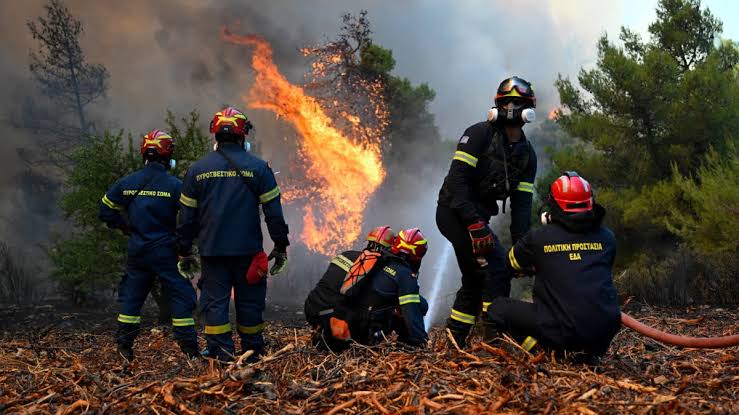
The summer’s wildfires are creating costs that extend far beyond emergency response.
By early August, more than 490,000 hectares had burned across the European Union, compared with a 20-year average of approximately 197,000 hectares for the same stage of the year, according to European wildfire data cited in the analysis. France had already recorded an unprecedented fire season.
Destroyed forests and ecosystems represent economic assets even when their losses do not appear immediately in conventional GDP calculations.
Triodos estimates that lost ecosystem services associated with burned areas could add anywhere between €100 million and €4.6 billion to the overall damage.
Those losses can include reduced carbon absorption, biodiversity destruction, soil degradation, water-management impacts and lost recreational or tourism value.
The human cost largely remains outside GDP
The headline €180 billion estimate does not capture the entire impact.
One of the largest omissions is mortality.
Approximately 20,400 heat-related deaths were estimated across France, Germany, Spain and Italy during the June heatwave alone.
For the summer as a whole, around 25,000 deaths are estimated in the Triodos analysis. Assigning an economic value to the life years lost would imply an additional cost of approximately €1.5 billion to €7 billion.
These figures underline one of the limitations of using GDP alone to measure the consequences of extreme weather.
Healthcare pressures, mortality, ecosystem destruction and deterioration in quality of life can generate enormous social costs without being fully reflected in conventional economic statistics.
Energy infrastructure becomes increasingly exposed
Europe's energy system is particularly sensitive to extreme temperatures.
Nuclear power plants require large volumes of water for cooling, and heatwaves can force operators to reduce output when river temperatures become too high.
Hydroelectric generation suffers during drought because reservoirs and waterways contain less water.
Conventional thermal plants can encounter similar cooling constraints.
Solar energy, despite benefiting from clear skies, can also become less efficient when panels operate under exceptionally high temperatures.
At the same time, households and businesses increase electricity consumption through air conditioning.
The combination creates a difficult equation: heat can simultaneously reduce available generation and increase demand.
For an EU economy already confronting questions surrounding energy prices and industrial competitiveness, climate-related disruption therefore represents another structural cost.
Agriculture transmits the shock directly to consumers
Agriculture provides another direct link between climate and inflation.
Extreme temperatures and water shortages can reduce harvests, affect livestock productivity and increase irrigation requirements.
When agricultural production declines, the consequences eventually reach supermarkets through higher food prices.
The ECB has already highlighted how previous droughts in Spain and Italy contributed to significant food-price increases. Olive oil prices, for example, were around 50% higher in January 2024 than one year earlier following severe drought conditions.
This means climate shocks can simultaneously weaken economic growth and increase prices — an uncomfortable combination for monetary policymakers.
Climate risk increasingly becomes financial risk
The consequences extend beyond individual companies and consumers.
The ECB has warned that climate-related disasters can deteriorate public finances through reconstruction spending, emergency assistance, lower tax revenues and additional government support for food or energy costs.
Severe climate shocks can ultimately contribute to higher sovereign borrowing costs, particularly where governments already carry substantial debt burdens.
Climate change is therefore increasingly entering the calculations of central banks, insurers, investors and financial regulators.
What was once predominantly considered an environmental externality is becoming a measurable macroeconomic and financial risk.
Adaptation could significantly reduce the losses
The Triodos research estimates that adaptation measures could reduce heat-related productivity losses by approximately 40%.
That would represent a substantial economic benefit, although it would not eliminate the consequences of increasingly extreme summers.
Adaptation can take multiple forms: cooling infrastructure, urban vegetation, more resilient electricity grids, improved water management, redesigned working hours, better-insulated buildings and transport systems capable of operating under extreme temperatures.
For governments, these measures require substantial investment.
For companies, however, many could increasingly become ordinary competitiveness investments.
A warehouse that remains operational during a heatwave, a factory capable of maintaining production or an office where employees remain productive can have a measurable economic advantage over less-prepared competitors.
Europe's climate challenge becomes a competitiveness challenge
The estimated €180 billion economic impact illustrates how the climate debate is changing.
Europe is no longer dealing solely with projections of what global warming could cost several decades from now. Extreme weather is already affecting output, labour productivity, food prices, energy systems, infrastructure and public finances.
The question for businesses and governments is consequently shifting from whether adaptation is necessary to how quickly investment can reduce economic exposure.
Mitigation remains essential because adaptation has limits. But the 2026 summer demonstrates that resilience itself is becoming an economic asset.
If Triodos' estimate proves close to reality, extreme heat could consume almost the equivalent of an entire year of expected EU economic growth.
Europe's scorching summer is therefore sending a message that extends far beyond climate policy: in an increasingly hotter continent, the ability to withstand extreme weather is becoming a fundamental component of economic competitiveness.