Marcelo Elizondo: "The EU agreement changes Mercosur’s matrix and opens a new cycle of trade and investment”
In an exclusive interview with EUBizNews, international trade expert Marcelo Elizondo says the EU-Mercosur agreement could transform the South American bloc from an inward-looking market into a platform for global integration, while accelerating European investment in Argentina and strengthening economic ties between Europe and Latin America.

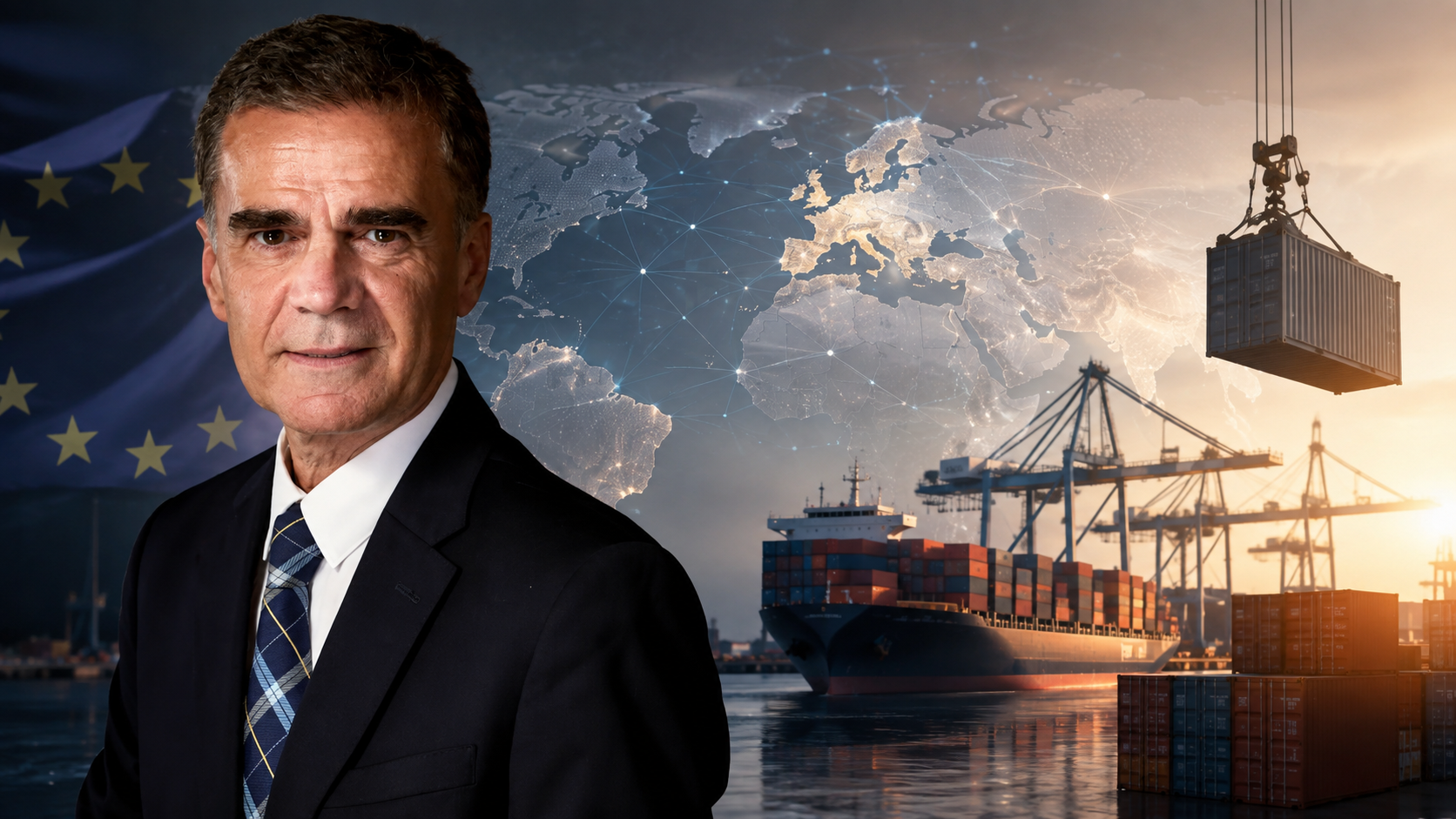
The EU-Mercosur agreement could mark a structural turning point in the economic relationship between Europe and South America, transforming a historically inward-looking Mercosur into a platform for international trade, investment and deeper integration with global markets. After more than 25 years of negotiations, its significance could ultimately extend far beyond tariff reductions.
That is the assessment of Marcelo Elizondo, international trade consultant and international speaker, who told EUBizNews that preferential access to the European Union creates an opportunity to rethink the role Mercosur plays in the global economy. For Argentina in particular, the agreement could open new opportunities for exports and European investment in sectors ranging from agribusiness and services to energy and critical minerals.
“The agreement with the European Union changes Mercosur’s matrix,” Elizondo said in an exclusive interview. “Until now, it has been a closed, inward-looking bloc, essentially focused on integration among Mercosur members rather than serving as a platform towards third markets.”
Connecting Mercosur with an EU market of around 450 million consumers with high purchasing power changes that equation. Elizondo pointed to Argentine government projections indicating that trade between the two blocs could increase by around 70% over the next five years, with Argentina particularly well positioned to benefit in sectors where it already has competitive advantages.
Agriculture and livestock are obvious candidates, but Elizondo sees a much broader opportunity. Agri-food, mining, energy, regional agricultural industries and services could all gain from improved access to the European market, potentially expanding the economic impact of the agreement beyond traditional commodity exports.
The challenge for Argentina will be to convert market access into additional productive capacity. An agreement can remove tariffs and facilitate trade, but businesses still need investment, financing, infrastructure and competitive domestic conditions to respond to new demand. In that sense, the EU-Mercosur agreement could become as important for capital flows as it is for exports.
European investment could become one of the agreement’s biggest effects
Elizondo believes stronger trade ties could act as a catalyst for European investment in Argentina and South America, following a pattern already seen in other markets with which the EU has developed preferential trade relationships.
“Investment goes where there is access to markets,” he said, arguing that European companies have an incentive to invest in economies where production can subsequently connect with wider markets through trade agreements. Although EU-Mercosur is primarily a commercial framework, greater predictability and preferential access can change the calculations behind long-term corporate investment.
For Argentina, that could be particularly relevant in energy, mining, agribusiness and services. The country has major resources in lithium, copper and natural gas, enormous agricultural capacity and an established knowledge economy. Those assets increasingly overlap with European priorities as the EU seeks to diversify supplies of energy, food, critical raw materials and other strategic inputs.
But Elizondo cautions against assuming that resources alone will bring investment. Argentina must create the domestic conditions required to turn those advantages into a long-term export strategy. His first priority is macroeconomic stability.
“Argentina needs, first of all, to put its macroeconomy in order, because it is impossible to compete without macroeconomic stability,” he said. Elizondo believes progress is being made but argues that the process remains unfinished.
Institutional predictability is the second requirement. Companies considering large investments — particularly in mining, energy and infrastructure — need confidence that rules and economic conditions will remain sufficiently stable over the life of projects that may require years before generating returns. Deregulation is another priority, as Elizondo believes Argentina still carries substantial regulatory and bureaucratic costs that undermine competitiveness.
Macroeconomic stabilisation will also have to translate into better financing conditions for productive businesses. Argentina needs greater domestic and foreign investment to expand output, and access to credit will be essential if local companies are to take advantage of a larger European market.
For Elizondo, these reforms ultimately converge around a single objective: increasing Argentina’s productive capacity. Preferential access to Europe will have limited value if exporters cannot scale production, invest in technology or meet the standards required by European customers.
The agreement is also arriving as the global trading system undergoes a profound geopolitical transformation. Tensions between the United States and China, higher tariffs, industrial subsidies and the reorganisation of supply chains have generated expectations of a more protectionist and fragmented world. Elizondo, however, argues that global trade remains resilient, pointing to international commerce reaching approximately $35 trillion in 2025 despite the proliferation of trade restrictions.
Against that backdrop, EU-Mercosur represents a different response to geopolitical uncertainty: institutionalised economic integration rather than retreat. While some countries are raising barriers, Europe and South America are creating a framework designed to lower them.
That could give the relationship broader strategic relevance. The European Union is seeking greater economic security and diversified suppliers, while Latin America needs capital, technology and access to high-value markets. The complementarity is particularly visible in energy, food and critical minerals, where European demand intersects with some of South America’s strongest productive advantages.
The opportunity is therefore not necessarily for Latin America to choose between the United States, China and Europe. Instead, closer ties with the EU could allow the region to diversify its own economic relationships while giving Europe a stronger position in a part of the world where China has significantly expanded its commercial presence.
There is, however, another side to European market access. Lower tariffs do not mean lower regulatory requirements. Latin American companies seeking to expand in Europe will still face demanding environmental, sanitary, technical and traceability standards.
“Europe is a market that opens with the agreement and offers major opportunities, but it is very demanding in terms of non-tariff regulations,” Elizondo said.
For exporters, that creates both a challenge and a potential competitive advantage. Compliance can require investment in certifications, technology, traceability and production processes, increasing the initial cost of entering the European market. Other regions may impose fewer non-tariff requirements even when their tariffs are higher.
Yet companies capable of meeting European standards can also strengthen their competitiveness elsewhere. Compliance with some of the world’s most demanding environmental, sanitary and technical rules can become a commercial credential in its own right, particularly as global supply chains increasingly demand greater transparency and traceability.
Europe and Latin America could move from trade to integrated business ecosystems
Looking towards 2030, Elizondo expects the economic relationship between Europe and Latin America to become considerably deeper than a simple increase in exports and imports. His scenario includes more trade in goods and services, greater European investment in Argentina and the rest of South America, and an increase in Latin American companies investing in Europe.
“I imagine much greater integration,” he said. “There will be much more trade in goods and services, much more inward investment — European investment coming here — and also more outward investment, with Argentine companies investing in Europe.”
That bidirectional flow of capital would represent an important evolution. European companies have been major investors in Latin America for decades, but the next phase could see more Argentine and regional businesses using Europe as a platform for expansion, partnerships and internationalisation.
Elizondo argues that the transformation of global business itself makes that scenario increasingly plausible. International production is no longer organised exclusively around linear value chains in which one country supplies raw materials and another manufactures the final product. Companies increasingly operate through business ecosystems connecting production, technology, investment, finance, logistics and services across multiple countries.
The EU-Mercosur agreement could provide an institutional foundation for more of those ecosystems to emerge across the Atlantic. A mining or energy project in Argentina, for example, can involve European capital and technology, local suppliers, digital services, renewable power, international logistics and customers across several markets. Agribusiness and the knowledge economy can generate similar networks.
That is where the agreement’s longer-term impact could exceed the immediate benefits of lower tariffs. If companies begin building integrated production and investment networks between Europe and South America, the relationship could evolve from conventional bilateral trade towards a more strategic form of economic integration.
Structural obstacles remain. Argentina still needs greater macroeconomic stability, stronger institutional predictability, deeper financing markets and lower regulatory costs. Latin American exporters will also have to adapt to an increasingly demanding European regulatory environment. On the European side, companies will need to understand the risks and opportunities of markets that remain more volatile than the EU’s traditional investment destinations.
But Elizondo sees the potential for a new cycle. After more than a quarter-century of negotiations, the EU-Mercosur agreement could become the catalyst for a broader realignment between Europe and Latin America: one in which European investment helps expand South American productive capacity, Latin American companies gain access to one of the world’s largest high-income consumer markets and both regions diversify their economic relationships amid growing global fragmentation.
For Mercosur, the transformation could be particularly profound. Rather than functioning primarily as a protected regional market, the bloc could begin to serve as a platform connecting South America with global trade and investment networks.
And for Argentina, the central question is no longer simply whether Europe will open its market. It is whether the country can build the competitiveness, investment climate and productive capacity required to take advantage of that opening.