Alstom’s guidance cut: what it means for Europe’s rail infrastructure
Alstom’s sharp financial guidance downgrade and operational review expose a challenge that extends beyond one manufacturer: Europe’s ability to convert strong rail demand and large order books into projects delivered on time, at predictable cost and with sustainable margins.

Alstom, one of Europe’s most important rail manufacturers, has entered a period of heightened scrutiny after sharply cutting its financial outlook and announcing a broad review of its organisational and operational model.
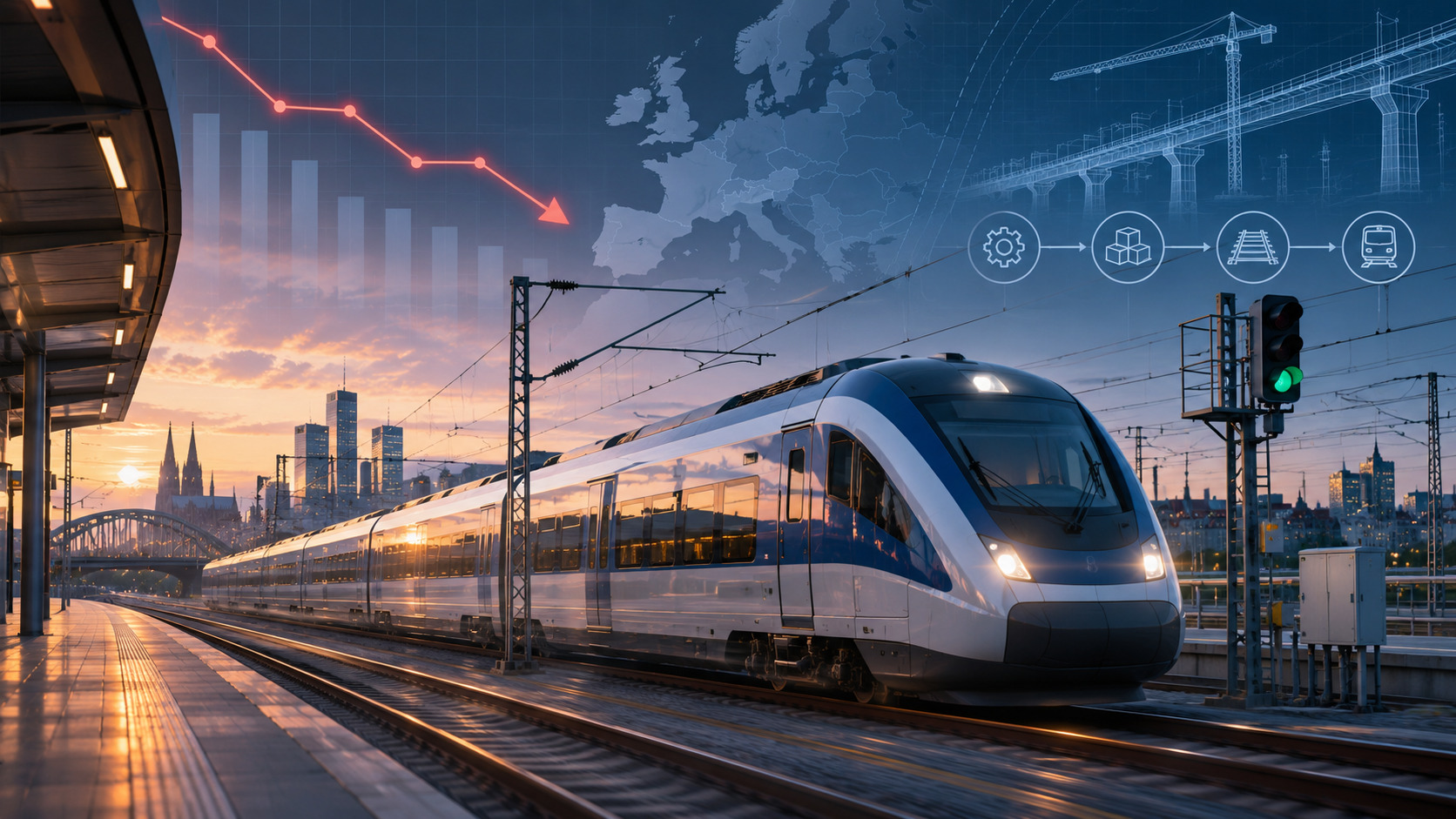
The scale of the adjustment is significant. For fiscal year 2026/27, the company now expects an adjusted EBIT margin of around 1%, compared with 6.5% previously, while free cash flow is forecast at approximately –€1.5 billion, reversing an earlier expectation of positive cash generation.
Alstom also reduced its production target to around 4,000 rail cars, from 4,400–4,500 previously, and lowered its organic sales growth forecast from around 5% to the low- to mid-single-digit range.
The deterioration is mainly linked to execution problems in European rolling-stock projects, particularly the Coradia Max platform and other contracts executed for and from Germany. Extended homologation timelines, technical issues and additional work have affected project margins, production and the timing of milestone payments.
For Europe’s rail sector, however, the most important point is not simply that one major industrial company has missed its forecasts.
The broader question is whether Europe’s increasingly ambitious transport agenda can be supported by an industrial model capable of managing complex, multi-year contracts, technical certification, supply-chain pressures and working-capital requirements without destabilising the companies expected to deliver them.
Strong demand, difficult execution
There is an important distinction between Alstom’s commercial position and its operational performance.
Demand remains strong.
During the first half of fiscal 2026/27, the group received €11 billion in orders, up from €10.5 billion a year earlier, with a book-to-bill ratio of 1.2. Sales reached €9.3 billion, increasing 3% on a reported basis.
The problem lies in converting that demand into profitable and cash-generative execution.
Alstom’s first-half adjusted EBIT margin fell to approximately –4%, compared with 6.4% one year earlier, while free cash flow reached –€1.248 billion.
This distinction matters for European infrastructure policy.
A large order book can demonstrate underlying demand for rail investment, but it does not guarantee that projects will be delivered according to their initial financial assumptions. The more technically complex the contracts become, the greater the importance of project management, realistic pricing, certification schedules and contractual risk allocation.
The problems affecting Coradia Max illustrate that challenge particularly clearly.
Delays in homologation do not only postpone the entry into service of trains. They can also shift customer payments into later periods, increase engineering and industrial costs, require modifications to already manufactured units and create knock-on effects across production schedules.
That makes execution risk a financial issue as much as an engineering one.
What Alstom’s problems mean for infrastructure projects
It would be premature to interpret Alstom’s warning as evidence of a broader European rail crisis.
But the episode does highlight vulnerabilities that public authorities and infrastructure investors cannot ignore.
Europe is seeking to expand high-speed rail, improve regional networks, modernise signalling and increase cross-border connectivity at the same time that manufacturers must absorb higher technological complexity and tighter delivery requirements.
When a supplier of Alstom’s scale encounters difficulties on a major platform, the effects can extend through operators, infrastructure managers, component suppliers, maintenance programmes and public procurement schedules.
For contracting authorities, this strengthens the case for closer monitoring of technical milestones and supplier capacity throughout the life of a project rather than concentrating primarily on the initial tender.
It also raises questions about how risk is distributed.
Contracts that transfer excessive inflation, certification or technological risk to manufacturers may initially appear advantageous to buyers, but they can become counterproductive if financial assumptions prove unrealistic over projects lasting many years.
Conversely, suppliers must demonstrate that they can price contracts with sufficient discipline and identify technical problems before they become financially material.
Alstom’s current difficulties therefore point towards a broader principle for European infrastructure: financial resilience and industrial execution are becoming inseparable from infrastructure resilience itself.
A €2 billion balance-sheet challenge
Alstom’s response extends beyond operational improvements.
The company has announced an objective to reduce debt by approximately €2 billion by September 2027, while reviewing potential organic and inorganic measures.
Management is also pursuing leaner operations, stronger cost and procurement discipline, faster resolution of project issues, greater managerial accountability and simpler processes.
A broader review of the company’s organisational structure, industrial footprint and product offering is under way, with key decisions expected in early 2027.
The balance-sheet dimension deserves attention.
Net debt increased to approximately €1.1 billion at the end of September, compared with €0.4 billion at the end of March, largely reflecting the first-half cash outflow.
At the same time, Alstom retains substantial liquidity and has reinforced its financing capacity, meaning the present situation should not automatically be interpreted as a liquidity crisis.
Rather, the challenge is to preserve investment-grade financial strength while correcting projects that consume substantially more cash and margin than originally anticipated.
Financial markets nevertheless responded sharply to the warning, reflecting the speed with which confidence can deteriorate when industrial execution problems translate into large changes in expected cash generation.
For investors, the key question is no longer simply whether demand for rail infrastructure will grow. That outlook remains structurally attractive.
The question is how much of that demand can be converted into profitable, predictable and cash-generative business.
The risk for Europe’s industrial ambitions
The implications extend beyond Alstom itself.
Rail is central to Europe’s decarbonisation and transport strategy. The continent needs manufacturers capable not only of winning orders, but also of financing long production cycles, absorbing technological development costs and maintaining large industrial footprints.
That makes the financial health of companies such as Alstom strategically relevant.
Pressure to repair margins and cash flow could encourage greater selectivity over future contracts, stricter pricing discipline and a stronger focus on projects where risks can be controlled.
In the short term, this could make procurement more demanding for public-sector clients.
In the longer term, however, greater discipline may be necessary if Europe wants a rail supply chain capable of investing continuously in digital signalling, energy-efficient rolling stock, automation and new mobility technologies.
The alternative — manufacturers accumulating large order books that do not generate adequate returns — would ultimately be more damaging to European infrastructure capacity.
A test of Europe’s infrastructure model
Alstom expects its performance to begin normalising from fiscal year 2027/28 and continues to target an adjusted EBIT margin of 8% to 10% over the medium term.
Whether it can reach that objective will depend heavily on the execution of its operational plan and the stabilisation of its most problematic projects.
For Europe, the case offers a broader lesson.
The continent does not lack demand for railway investment. In many markets, the pipeline remains substantial.
The challenge is ensuring that ambitious infrastructure policies are accompanied by realistic procurement models, financially sustainable contracts, resilient supply chains and manufacturers capable of delivering increasingly complex projects without eroding their balance sheets.
Alstom’s warning is therefore best understood not as evidence that Europe’s rail ambitions are failing, but as a stress test for the industrial model expected to deliver them.
As Europe accelerates investment in sustainable mobility, the resilience of its infrastructure will increasingly depend on the financial discipline, operational execution and strategic adaptability of the companies building it.