NEURA Robotics acquires Adlatus as €1.2 billion war chest fuels European Physical AI expansion
The German robotics company is buying 100% of autonomous cleaning specialist Adlatus and plans to connect its machines to the Neuraverse, weeks after another acquisition from Bosch Rexroth. The strategy points to a broader ambition: building shared AI infrastructure for robots operating in the physical world.

German robotics company NEURA Robotics is accelerating its expansion into Physical AI with the acquisition of 100% of Adlatus Robotics, an Ulm-based manufacturer of autonomous cleaning machines, as it begins deploying the capital from a financing round of up to €1.2 billion completed earlier this summer.
The transaction is being carried out through NEURA Mobile Robots, the group’s logistics and automated-vehicle division. Financial terms of the acquisition were not disclosed. The deal will bring Adlatus’s installed fleet of autonomous cleaning and sweeping robots into NEURA’s broader Neuraverse, a platform designed to allow intelligent machines to learn, share capabilities and operate through a common AI ecosystem.
The move reflects a strategy that extends well beyond cleaning robots. NEURA wants to build an infrastructure layer for machines capable not only of navigating physical environments but also of understanding what they see, adapting their behaviour and learning from real-world deployments.
“We’re not buying ADLATUS just to add another cleaning robot to our portfolio. We want to give machines like this a new brain,” NEURA founder and CEO David Reger said. He described professional cleaning as a large global labour market and an example of the activities that Physical AI could transform.
Adlatus brings more than two decades of experience in autonomous cleaning systems used across industry, logistics, healthcare and commercial and public facilities. Hundreds of its machines are already operating in the field, while the company has also developed proprietary navigation software and accumulated operational knowledge around autonomous cleaning in complex environments.
NEURA plans to add sensors and AI capabilities to those machines and gradually connect them to the Neuraverse. The longer-term objective is to move beyond robots that simply follow predefined routes. A connected cleaning robot could eventually distinguish between surfaces and different kinds of dirt, interpret its surroundings, select an appropriate cleaning strategy and improve its performance through experience.
That vision illustrates the shift now taking place in European robotics. Traditional automation was largely built around machines programmed to execute a narrow set of repetitive tasks. Physical AI aims to give robots a greater ability to perceive, reason and adapt in environments that are less predictable than conventional factory production lines.
NEURA turns acquisitions into a platform strategy
The Adlatus deal is the latest in a rapid series of moves by NEURA.
Only weeks earlier, NEURA Mobile Robots agreed to acquire Bosch Rexroth’s ACTIVE Shuttle automated guided vehicle business, including the ACTIVE Fleet Manager and ROKIT navigation software. NEURA intends to make those technologies available through the Neuraverse as well, giving the platform capabilities spanning logistics, navigation and autonomous mobile robotics.
Taken together, the acquisitions suggest NEURA is not merely trying to enlarge its product catalogue. It is assembling technologies, software and installed robot fleets that can feed into a common intelligence layer.
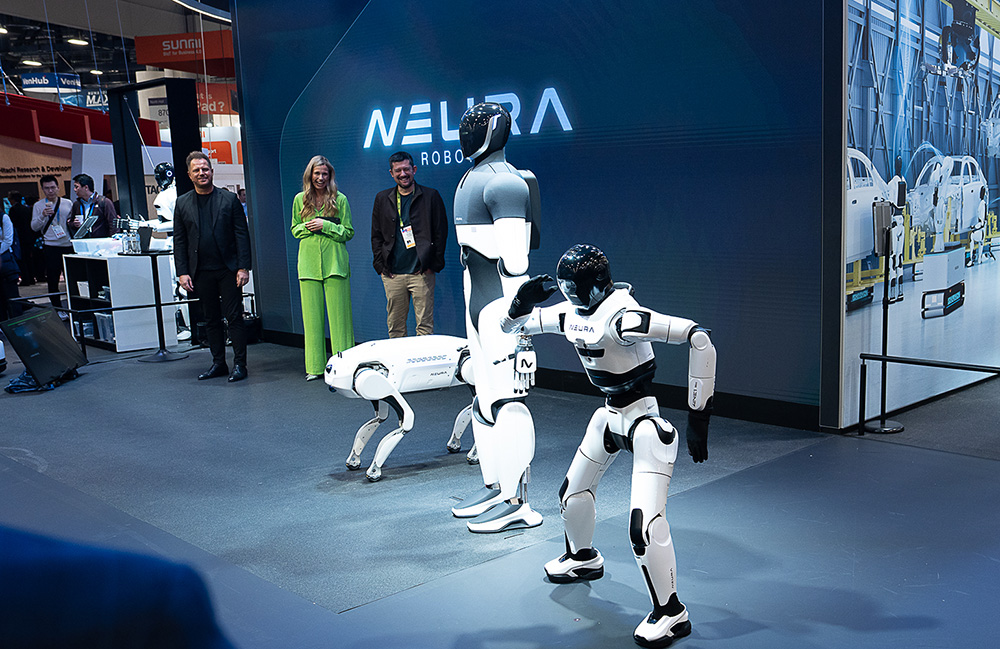
Founded in 2019, the Metzingen-based company already develops cognitive robots including the humanoid 4NE1 and the MAiRA and LARA robotic arms. Its architecture combines robotics hardware, artificial intelligence, sensors, edge computing and large-scale learning infrastructure.
The underlying premise is that individual robots become more valuable when they can learn from one another rather than operate as isolated systems.
Reger argues that this network effect will be essential if Physical AI is to move beyond pilot projects and into mass deployment.
“Physical AI will only truly scale if it becomes an ecosystem,” he said.
NEURA is also keeping the door open to other manufacturers. The company says the Neuraverse is intended to become infrastructure that third-party makers of cleaning machines and mobile robots could eventually connect to, rather than an ecosystem restricted exclusively to NEURA hardware.
That approach could become strategically important. The battle in robotics may increasingly shift from individual machines toward the operating systems, AI platforms and training infrastructure connecting them.
A record €1.2 billion financing gives NEURA room to scale
The acquisition spree follows NEURA’s largest financing to date.
In June, the company announced a Series C of up to €1.2 billion, which it described as the largest funding round ever raised by a full-stack robotics company. Investors included Tether, Qualcomm Technologies, Amazon, NVIDIA, imec.xpand, Bosch, Schaeffler, the European Investment Bank, Lingotto Horizon and InterAlpen Partners.
The scale of that backing gives NEURA an unusually large capital base for a European robotics company and allows it to pursue growth simultaneously through product development, manufacturing capacity and acquisitions.
Its existing order book and deployment pipeline already exceed €864.8 million, according to company figures cited by EU-Startups. The new capital is intended partly to increase manufacturing towards several million robots in production by 2030 and to expand the company’s network of “NEURA Gyms,” real-world environments where cognitive robots can collect data, practice tasks and improve their capabilities.
The strategy arrives at a moment when robotics and AI are converging rapidly. Much of the recent artificial-intelligence boom has been centred on software, but investors and industrial groups are increasingly turning their attention toward systems capable of applying AI in factories, warehouses, hospitals, public spaces and other physical environments.
Europe already has strong industrial and engineering capabilities in robotics, but the next competitive phase may depend on whether companies can combine those strengths with AI models, computing infrastructure, data and large-scale manufacturing.
NEURA’s expansion is an attempt to build exactly that combination.
For Adlatus, the acquisition provides access to a broader AI platform and a significantly larger capital base. For NEURA, it adds an installed fleet of robots operating in real-world environments where the Neuraverse can be tested and expanded.
The strategic value therefore lies not only in the cleaning market.
Every robot connected to the platform can potentially become another source of operational data and another node in a network designed to improve machine intelligence collectively.
That is why the Adlatus deal may be more significant than its undisclosed purchase price suggests.
NEURA is increasingly positioning itself not simply as a European robot manufacturer, but as a company attempting to build the AI infrastructure on which different categories of physical machines could eventually operate.
And with up to €1.2 billion in new capital behind it, the German company now has the financial capacity to test whether that vision can scale.