Sweden targets Argentina and Brazil as EU-Mercosur deal opens new trade routes
Trade Minister Benjamin Dousa is visiting South America as Stockholm seeks to turn the EU-Mercosur agreement into new opportunities for Swedish companies in mining, energy, mobility, advanced industry and technology.

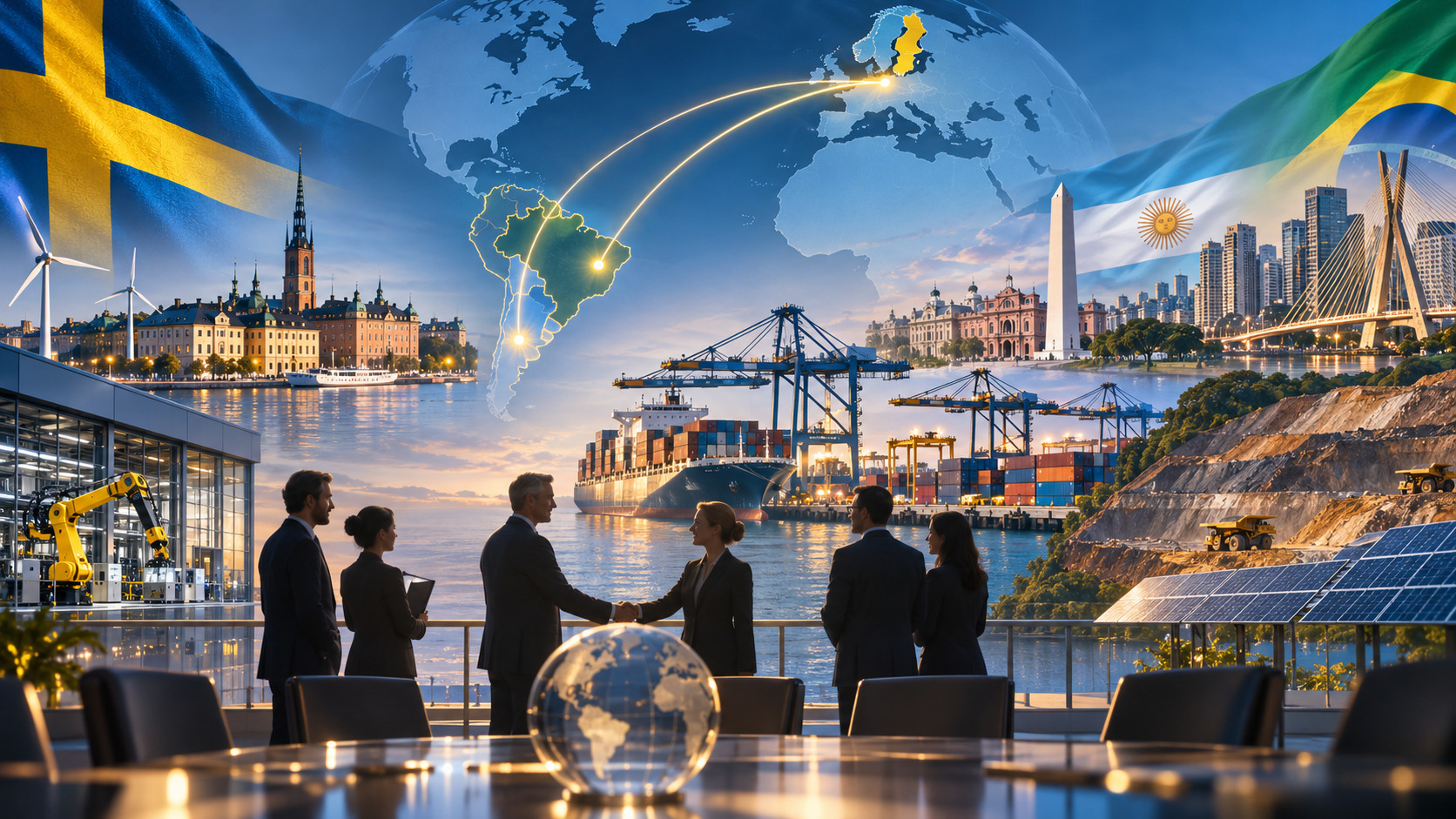
Sweden is moving to translate the EU-Mercosur trade agreement into concrete business opportunities in South America, with Trade Minister Benjamin Dousa visiting Argentina and Brazil from November 2 to 6 as Stockholm seeks to strengthen commercial ties with two of the region’s largest economies.
The trip comes six months after the EU-Mercosur Interim Trade Agreement began provisional application on May 1, opening a new phase in economic relations between Europe and Argentina, Brazil, Paraguay and Uruguay.
Sweden was among the European countries that strongly supported the agreement during the negotiation process. Now, Stockholm is looking to position Swedish companies to benefit from lower trade barriers and expanding investment opportunities.
“I am proud that Sweden has helped bring this to fruition,” Dousa said ahead of the visit, arguing that the agreement creates new opportunities for Swedish companies while strengthening links between the European Union and South America.
The Swedish government describes the new EU-Mercosur framework as one of the world’s largest free-trade areas, covering more than 700 million consumers.
Dousa’s first stop is Argentina, where he is scheduled to meet representatives from the government and private sector to discuss trade and investment flows. He will then travel to Brazil, where Sweden is also marking 200 years of diplomatic relations and where more than 250 Swedish companies already operate.
Argentina emerges as an investment opportunity
Argentina represents a different proposition from Brazil: a smaller Swedish corporate footprint, but a market that is attracting renewed attention because of its natural resources, industrial base and investment needs.
Business Sweden’s 2026 Business Climate Survey identifies significant opportunities in mining, the energy transition, industrial modernisation and infrastructure, as well as industrial equipment, transport, healthcare and advanced technologies.
Swedish companies already operating in the country reported relatively resilient financial performance despite the difficult macroeconomic environment.
Most respondents remained profitable, while turnover expectations were broadly positive. At the same time, companies continued to identify financial restrictions, taxation, regulatory complexity, customs procedures and macroeconomic volatility as obstacles to investment.
The survey included 33 Swedish companies operating in Argentina, most of which have been present in the market for more than five years.
For Stockholm, the EU-Mercosur agreement could alter part of that equation.
The deal does not eliminate every trade barrier immediately, but it has already begun reducing tariffs across sectors where Swedish industry is particularly competitive.
EU electric and hybrid vehicles entering Mercosur saw tariffs fall from 35% to 25% on the first day of provisional application, while tariffs on internal combustion vehicles were reduced from 35% to 17.5%.
For machinery and appliances, duties previously ranging between 14% and 20% will be progressively dismantled for 93% of EU exports, while pharmaceutical tariffs of up to 14% have also entered a gradual path towards elimination.
That creates a more favourable framework for European companies selling industrial machinery, transport technology, healthcare products and advanced manufacturing solutions into South American markets.
Brazil offers scale and an established Swedish industrial base
Brazil represents the more mature side of Sweden’s South American strategy.
More than 250 Swedish companies are already active in the country through subsidiaries, distributors or local partners, according to Business Sweden.
Swedish businesses have a long-established presence in sectors including industrial manufacturing, mobility, mining, energy, telecommunications, healthcare and professional services.
Brazil’s investments in infrastructure, digitalisation, industrial modernisation and the energy transition continue to create opportunities for companies offering advanced and sustainable technologies.
The country is also Sweden’s largest commercial platform in South America.
Business Sweden describes Brazil as a regional hub for corporate headquarters, while Swedish companies have operated in the market for more than a century.
Yet the challenges remain substantial.
Companies continue to cite tax complexity, bureaucracy, high financing costs, regulatory requirements and customs procedures among the principal obstacles to doing business.
The EU-Mercosur agreement is therefore relevant not because it removes those difficulties overnight, but because it reduces one of the structural barriers that European exporters have historically faced: high import tariffs.
From political support to commercial execution
The Swedish mission comes at a broader turning point in EU-Mercosur economic relations.
In 2025, the European Union exported €53.3 billion in goods to Mercosur, while imports from the bloc reached €56.1 billion.
European exports are concentrated in areas such as machinery, chemicals, pharmaceuticals and transport equipment — precisely the type of sectors where Swedish companies have strong capabilities.
For Stockholm, the opportunity extends beyond simple export growth.
Argentina and Brazil are increasingly important in European discussions around critical minerals, renewable energy, industrial supply chains, food systems and green technologies.
Swedish companies specialising in mining equipment, mobility, industrial machinery and clean technologies could therefore benefit not only from tariff reductions but also from the investment cycle required to expand those sectors.
That is particularly relevant in Argentina, where growing mining activity and energy investment are increasing demand for industrial technology, and in Brazil, where a large manufacturing base and infrastructure programme create opportunities at greater scale.
The visit also underscores a broader evolution in the EU-Mercosur relationship.
For decades, the agreement was primarily a political negotiation. Since May, however, it has become an operational framework that companies can actually use.
The challenge now is whether European governments and businesses can turn preferential market access into new exports, investment projects and long-term industrial partnerships.
For Sweden, the trip to Buenos Aires and São Paulo is an early attempt to do exactly that.
After years of advocating for the agreement, Stockholm is now shifting from diplomacy to execution — and testing whether Argentina and Brazil can become larger markets for Swedish technology, industry and investment in the new EU-Mercosur trade landscape.