Eurochambres Congress 2026 puts energy, AI and investment at the centre of Europe’s business agenda
Representatives from 91 chambers across 38 countries met in Valencia to discuss competitiveness, energy security, artificial intelligence, trade and the conditions needed to revive European investment and industry.

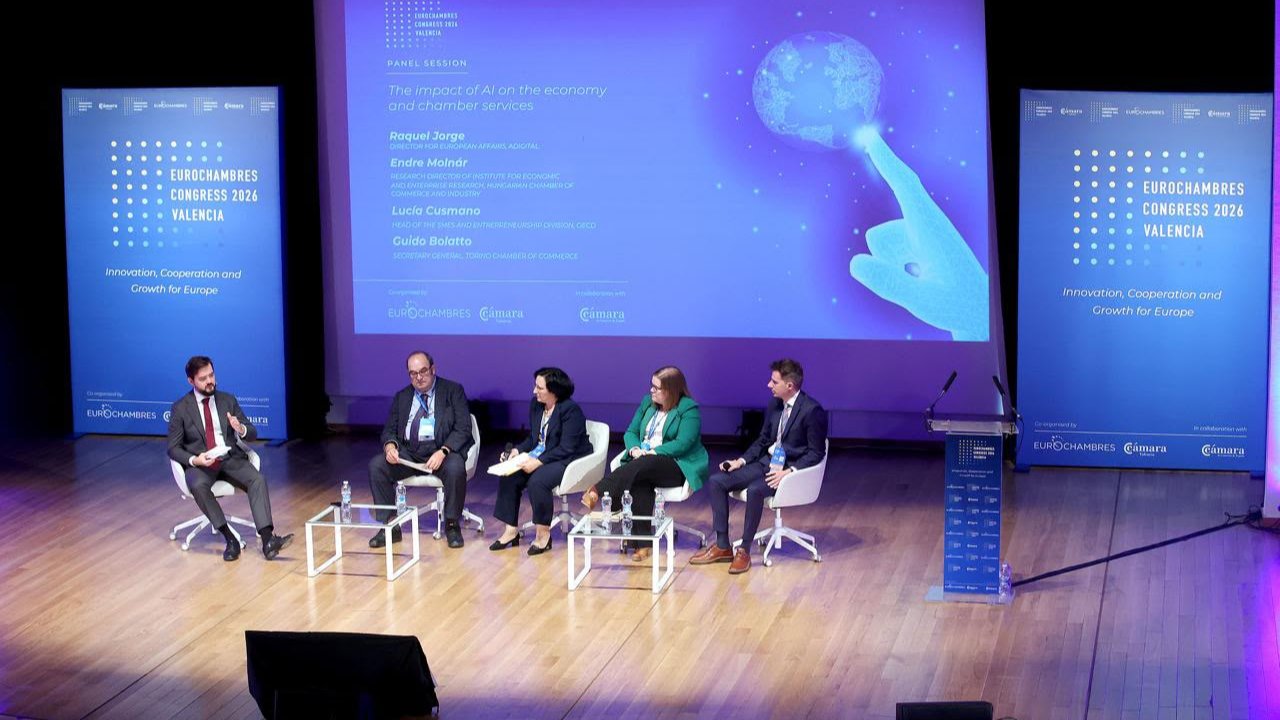
Representatives from 91 chambers across 38 countries gathered in Valencia on September 28 and 29 for the Eurochambres Congress 2026, a two-day meeting focused on the challenges facing European businesses and the role chambers of commerce can play in helping companies respond.
Hosted by the Valencia Chamber of Commerce, the event brought together chamber leaders, policymakers, business executives and experts to discuss issues ranging from energy security and artificial intelligence to trade, skills and investment.
Energy costs and security of supply featured prominently in the discussions. Iberdrola Executive Chairman Ignacio Galán highlighted Europe’s continued reliance on external energy sources, noting that around 60% of the continent’s energy needs depend on imports.
Galán argued that greater electrification could strengthen both European competitiveness and economic resilience, particularly as companies face pressure from higher energy costs and growing international competition.
AI and the single market
Artificial intelligence was another central topic, with participants examining how businesses are adopting new technologies and how chambers can help companies — particularly SMEs — navigate technological change.
The discussions also addressed persistent barriers within the European single market and the impact they can have on companies operating across borders.
Geopolitical uncertainty added another layer to the debate, as businesses increasingly need to manage supply-chain risks, changes in international trade and a more fragmented global economic environment.
The final policy session focused on Europe’s industrial revival and on the conditions required for companies to invest, innovate and expand.
One of the issues raised was how Europe could channel a greater share of its substantial household savings towards businesses and productive investment.
From policy debate to practical solutions
The Congress also placed emphasis on practical cooperation between chambers.
Sessions on sustainable competitiveness, international trade, talent and training were followed by workshops in which chamber representatives presented projects, experiences and services developed across the Eurochambres network.
The objective was to move beyond policy discussion and identify concrete ways in which chambers can support companies facing changing economic and regulatory conditions.
At the opening of the Congress, Eurochambres President Vladimír Dlouhý challenged chambers to assess whether they are sufficiently equipped to provide businesses with the support they need as circumstances evolve.
The discussions in Valencia reflected a broad consensus within the network that chambers will need to become increasingly agile, proactive and service-oriented to help their members adapt and remain competitive.
Latvia to host the next Eurochambres Congress
The 2026 Congress concluded with Valencia Chamber President José Vicente Morata formally handing over responsibility for the next edition to Aigars Rostovskis, President of the Latvia Chamber of Commerce and Industry.
Latvia will host the next Eurochambres Congress in 2028.
The gathering in Valencia reinforced the role of European chambers as intermediaries between businesses and policymakers at a time when companies are dealing simultaneously with technological transformation, geopolitical uncertainty, energy challenges and pressure to improve productivity and investment.