Antonio Garamendi re-elected to lead CEOE for four more years, with AI and social dialogue in focus
The Spanish business leader will begin a third term as CEOE approaches its 50th anniversary, prioritising artificial intelligence adoption, competitiveness, institutional stability and renewed social dialogue.

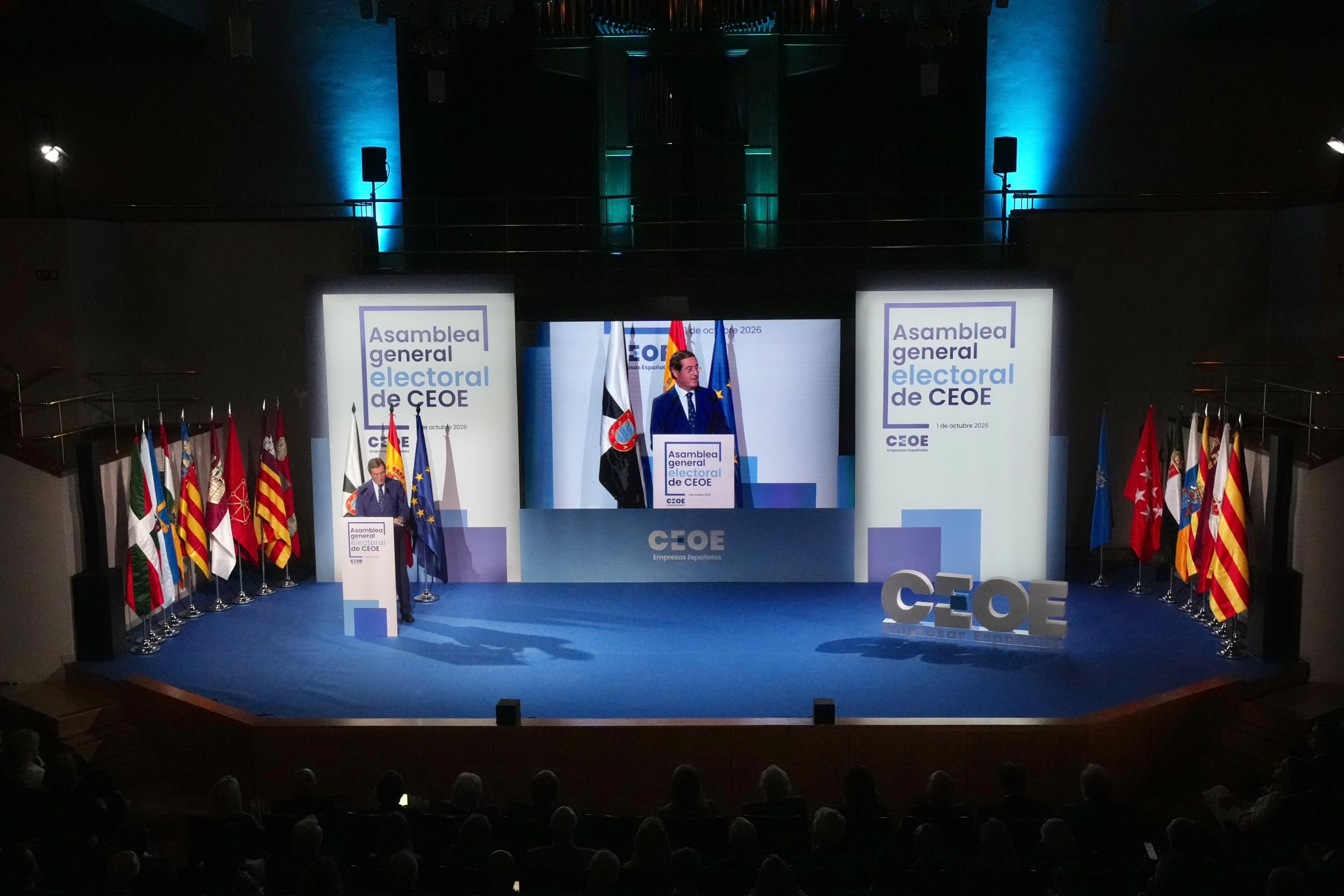
Antonio Garamendi will remain president of the Spanish Confederation of Business Organisations (CEOE) for another four years after being re-elected by acclamation during the organisation’s Electoral Assembly, held on Thursday at Madrid’s National Auditorium of Music.
His third term comes as CEOE prepares to celebrate its 50th anniversary in June 2027 and will place particular emphasis on the adoption of artificial intelligence across the business sector, competitiveness, institutional stability and the recovery of social dialogue.
“Companies face a double and unavoidable challenge: the technological development of AI and the need to strengthen a deeply humanistic vision of business,” Garamendi said during his speech following the vote.
He highlighted artificial intelligence as a key factor for competitiveness, while also stressing the ethical challenges associated with its deployment. According to Garamendi, balancing technological development with a people-centred approach will be one of the main pillars of his new mandate.
The CEOE president also placed institutional stability among his priorities, calling for respect for Spain’s Constitution and the separation and independence of state powers.
Social dialogue and collective bargaining
Garamendi reiterated his support for social dialogue and collective bargaining, describing them as essential mechanisms for economic prosperity, social welfare and professional development within companies.
He argued that future economic progress will require cooperation between companies, workers and institutions, with common goals and people at the centre of development.
One of the key issues on CEOE’s agenda will be the next Agreement for Employment and Collective Bargaining (AENC), which Garamendi described as one of the main pending agreements between employers and trade unions.
He said salary negotiations should be considered alongside other factors affecting labour costs and productivity, including absenteeism, social security contributions and taxation.
Private enterprise, housing and the single market
Garamendi also defended the economic and social framework established by the Spanish Constitution, particularly private initiative, freedom of enterprise and property rights.
On housing, he criticised what he described as insufficient public-sector action and argued that the private sector should not be expected to carry the full burden of addressing Spain’s housing challenges.
He also called for renewed dialogue between the country’s main political forces on issues of national importance, with greater institutional cooperation and adequate financing for public services and infrastructure.
Another priority identified by the CEOE president is the strengthening of Spain’s internal market by removing regulatory barriers that hinder the free movement of goods, services and capital.
International relations and Ibero-America
Foreign policy also featured prominently in Garamendi’s speech. He called for greater agreement around Spain’s strategic international priorities, including stronger relations with the United States, closer ties with Ibero-America and deeper cooperation with European partners and the European Union.
As part of this international agenda, Garamendi announced that CEOE is organising the XVI Ibero-American Business Meeting together with the Ibero-American Business Council (CEIB) and the Ibero-American General Secretariat (SEGIB).
The event will take place at Madrid’s Plaza de Las Ventas on November 3 and 4, alongside the 30th Ibero-American Summit of Heads of State and Government.
More than 1,000 business leaders are expected to attend, together with representatives from leading business organisations across the region and heads of state and government.
CEOE sees the meeting as an opportunity to strengthen Ibero-America’s role in an international environment increasingly shaped by changes in global trade, geopolitical tensions and pressure on the multilateral system.
CEOE prepares for its 50th anniversary
Garamendi’s new mandate will also coincide with CEOE’s 50th anniversary in 2027.
During his speech, he highlighted the role of Spain’s parliamentary monarchy and the Crown in supporting the country’s institutional continuity and international business presence.
The next four years are therefore expected to combine CEOE’s traditional role in labour relations and business representation with a growing focus on artificial intelligence, productivity, institutional reform and Spain’s position in international markets.