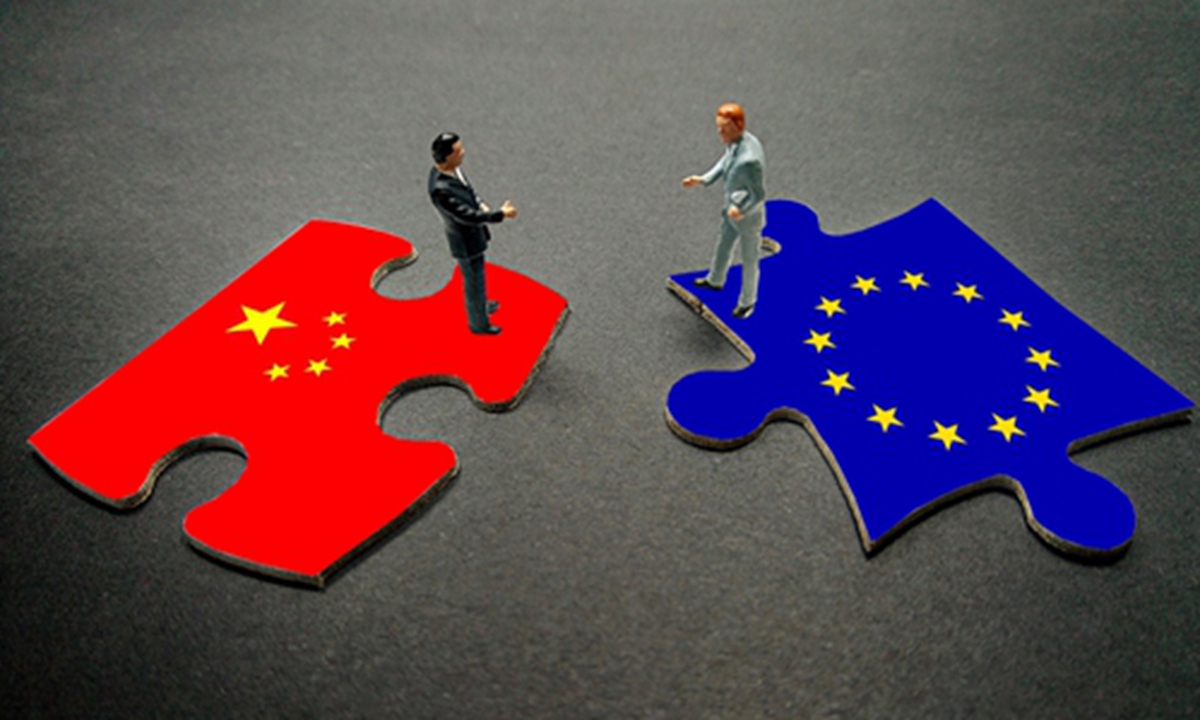
Europe’s China Test: Defending Industry Without Hiding Its Own Weaknesses
Brussels is right to challenge distortions in its economic relationship with China. But tariffs and import restrictions will achieve little if Europe fails to confront its own energy, regulatory and competitiveness problems.

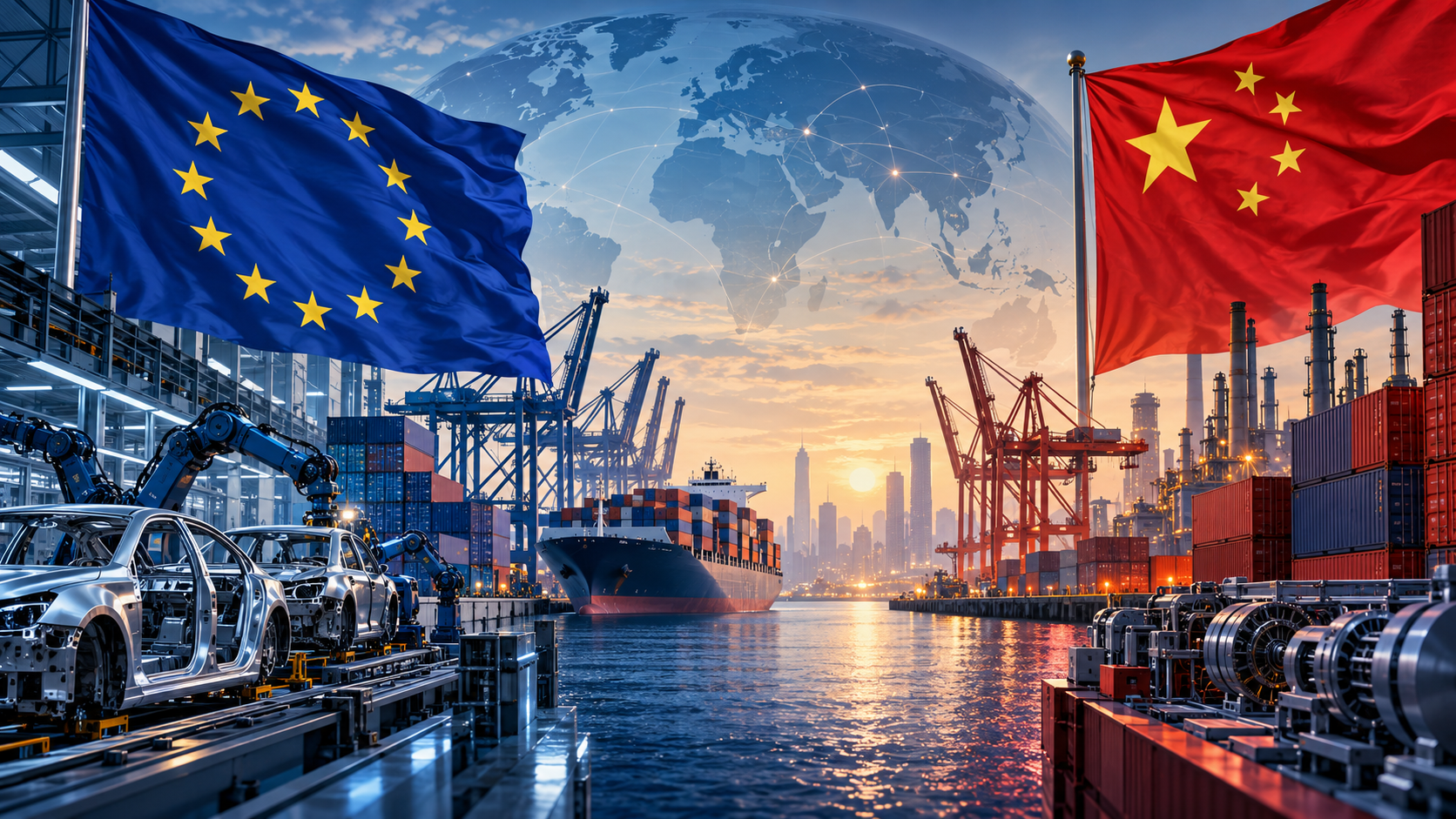
Europe’s economic relationship with China has reached a point at which maintaining the status quo is becoming increasingly difficult to defend. The European Union’s goods trade deficit with China stood at roughly €360 billion in 2025, according to Eurostat, while European exports to China declined and imports moved in the opposite direction. At the same time, pressure from Chinese manufacturing is spreading beyond electric vehicles into machinery, chemicals, plastics and other industrial sectors that remain central to Europe’s economic base.
Brussels is therefore considering a broader set of trade-defence measures after years in which the debate was largely concentrated on electric vehicles. The European Commission has also reached an agreement with Beijing aimed at sharply limiting imports of Chinese hybrid vehicles, with an annual quota of around 350,000 units, expected to increase by 6% per year.
It would be easy to reduce this debate to a confrontation between European protectionism and Chinese competitiveness. That interpretation, however, misses the central issue.
The problem is not simply that China has learned to manufacture goods more cheaply than Europe. Nor should European companies be protected indefinitely from more efficient foreign competitors. The more difficult question is whether genuine free competition can exist when companies operate under fundamentally different economic conditions, levels of state support and access to one another’s markets.
That is the question Europe can no longer avoid.
An imbalance Europe can no longer ignore
China’s industrial rise is one of the most remarkable economic transformations of modern history. European consumers and companies have benefited enormously from it through lower prices, larger supply chains and access to increasingly sophisticated manufactured products.
But acknowledging those benefits should not require ignoring the distortions that have accompanied China’s economic model.
The European Commission itself describes the relationship as “critically unbalanced”, pointing to extensive industrial support, manufacturing overcapacity, barriers to European companies operating in China and growing Chinese export controls over strategic raw materials and technologies.
This distinction matters.
There is an enormous difference between shielding an inefficient European producer from a genuinely more productive competitor and responding to an industrial system in which subsidies, preferential financing, state procurement, strategic industrial policy and restricted market access can alter the conditions under which competition takes place.
Europe should remain an open economy. But openness cannot sustainably mean granting foreign producers broad access to the Single Market while accepting persistent asymmetries for European companies abroad.
Reciprocity is not a rejection of free trade. Properly applied, it is one of the conditions that allows free trade to retain political and economic legitimacy.
The automobile industry illustrates the dilemma particularly well. Chinese manufacturers have become formidable competitors not only because of government support, but also because many of them are genuinely innovative, highly integrated and capable of producing technologically advanced vehicles at lower costs.
Pretending otherwise would be a mistake.
Europe cannot tariff its way out of technological competition.
Yet it would be equally naïve to ignore the role played by industrial policy and vast manufacturing capacity in shaping Chinese export prices. Volkswagen’s current restructuring — involving tens of thousands of jobs — reflects several problems at once: Chinese competition, excess European capacity, high costs, tariffs elsewhere and the expensive transition toward new automotive technologies.
China is part of the explanation. It is not the entire explanation.
Trade defence cannot replace competitiveness
This is where Europe must be particularly careful.
Trade-defence measures can provide breathing room for an industry facing a sudden import shock. They can also be justified where subsidies or other distortions materially affect competition.
What they cannot do is make an uncompetitive economy competitive.
Europe entered this confrontation with structural disadvantages of its own making. Energy remains expensive by international standards. The Single Market is still fragmented in important areas. Businesses face high regulatory and administrative costs. Capital markets remain less integrated than they should be, while European companies have struggled to scale innovation as successfully as competitors in the United States and China.
These problems were identified explicitly in Mario Draghi’s report on European competitiveness and have subsequently become central to the Commission’s own economic agenda.
If Brussels responds to Chinese competition only by restricting imports, it risks treating the symptom while leaving the disease untouched.
A tariff may protect a factory temporarily. It cannot lower electricity prices, deepen European capital markets, accelerate investment, simplify regulation or create the next generation of globally competitive technology companies.
The EU therefore needs two policies simultaneously: a credible trade-defence strategy against demonstrable distortions and a much more ambitious domestic competitiveness agenda.
Without the second, the first risks becoming permanent protectionism.
Europe’s dangerous dependence on China
There is another reason why Brussels cannot simply escalate without calculation: Europe remains deeply dependent on China across crucial parts of its industrial supply chain.
The vulnerability is particularly visible in critical raw materials and permanent magnets used in electric vehicles, wind turbines, electronics and advanced manufacturing. The European Commission estimates that China supplies 98% of EU demand for rare-earth permanent magnets, while dependence is even higher in some individual heavy rare-earth categories.
That gives Beijing substantial leverage.
China has already demonstrated its willingness to use export controls over critical materials and technologies as an instrument of economic policy. Europe therefore faces an uncomfortable contradiction: it wants to reduce the competitive pressure generated by Chinese industrial production while remaining dependent on Chinese inputs for many of the technologies it considers strategic.
That is why “de-risking” is more realistic than complete decoupling.
Europe needs alternative suppliers, domestic processing capacity, recycling, strategic reserves and stronger partnerships with economies capable of supplying minerals and intermediate goods. What it does not need is an economically unrealistic attempt to separate itself entirely from the world’s second-largest economy.
A trade war would impose costs on both sides.
But fear of retaliation cannot become an argument for permanent passivity either. If economic dependence means that Europe is unable to respond to practices it considers unfair because Beijing might restrict critical supplies, then the dependency itself has become a strategic vulnerability.
Latin America could gain — and lose
The implications extend well beyond Europe and China.
For Latin America, a restructuring of global trade flows creates genuine opportunities. European companies looking to diversify suppliers may increasingly consider Latin American producers of minerals, food, industrial inputs, chemicals and manufactured goods. The region could also benefit from European efforts to reduce strategic dependence on a limited number of Asian suppliers.
But there is another side to the equation.
If Chinese products face greater barriers in Europe and the United States, some of that production will inevitably search for alternative markets. Latin America could become one of the destinations for this redirected supply.
That would benefit consumers and companies purchasing cheaper capital goods. But it could also intensify pressure on domestic manufacturers in industries such as steel, automobiles, machinery, chemicals, textiles and consumer products.
The result could be a second-order version of the same debate now unfolding in Europe.
Latin American governments should therefore resist simplistic responses. Blocking imports merely to preserve inefficient industries would reduce productivity and increase costs. But ignoring the consequences of heavily subsidised industrial overcapacity would be equally short-sighted.
The real opportunity lies in positioning the region as a credible alternative supplier and investment destination rather than merely as the next market absorbing excess global production.
The real choice facing Europe
Europe’s debate over China is often presented as a choice between free trade and protectionism. That framing is increasingly inadequate.
The more relevant question is whether an open European market can remain politically and economically sustainable when it faces an industrial system backed by extensive state support, enormous manufacturing capacity and persistent asymmetries in market access.
Europe is justified in demanding reciprocity and responding to proven trade distortions. It is also justified in reducing dangerous strategic dependencies.
But Brussels should avoid the temptation to blame China for weaknesses that Europe created itself.
High energy costs are not made in Beijing. Fragmented capital markets are not made in Beijing. Excessive bureaucracy, slow permitting, limited scale and years of insufficient investment in strategic technologies cannot simply be attributed to Chinese competition.
Trade barriers may give European industry time.
What Europe does with that time will determine whether the current policy shift becomes a successful industrial renewal or merely a more expensive form of managed decline.
China has created a serious competitive challenge for Europe. The answer should not be economic isolation. Nor should it be passive acceptance of an increasingly asymmetric relationship.
Europe needs something more difficult: open markets with enforceable rules, strategic resilience without autarky, and an industrial policy capable of competing rather than merely protecting.
That is the balance Brussels now has to find.