Europe’s green fence: Latin America faces the EU deforestation compliance challenge
The EUDR is turning sustainability into a condition for accessing the European market, requiring Latin American exporters to strengthen traceability, geolocation and due diligence. For the region, the challenge is no longer only environmental — it is also technological, legal and economic.

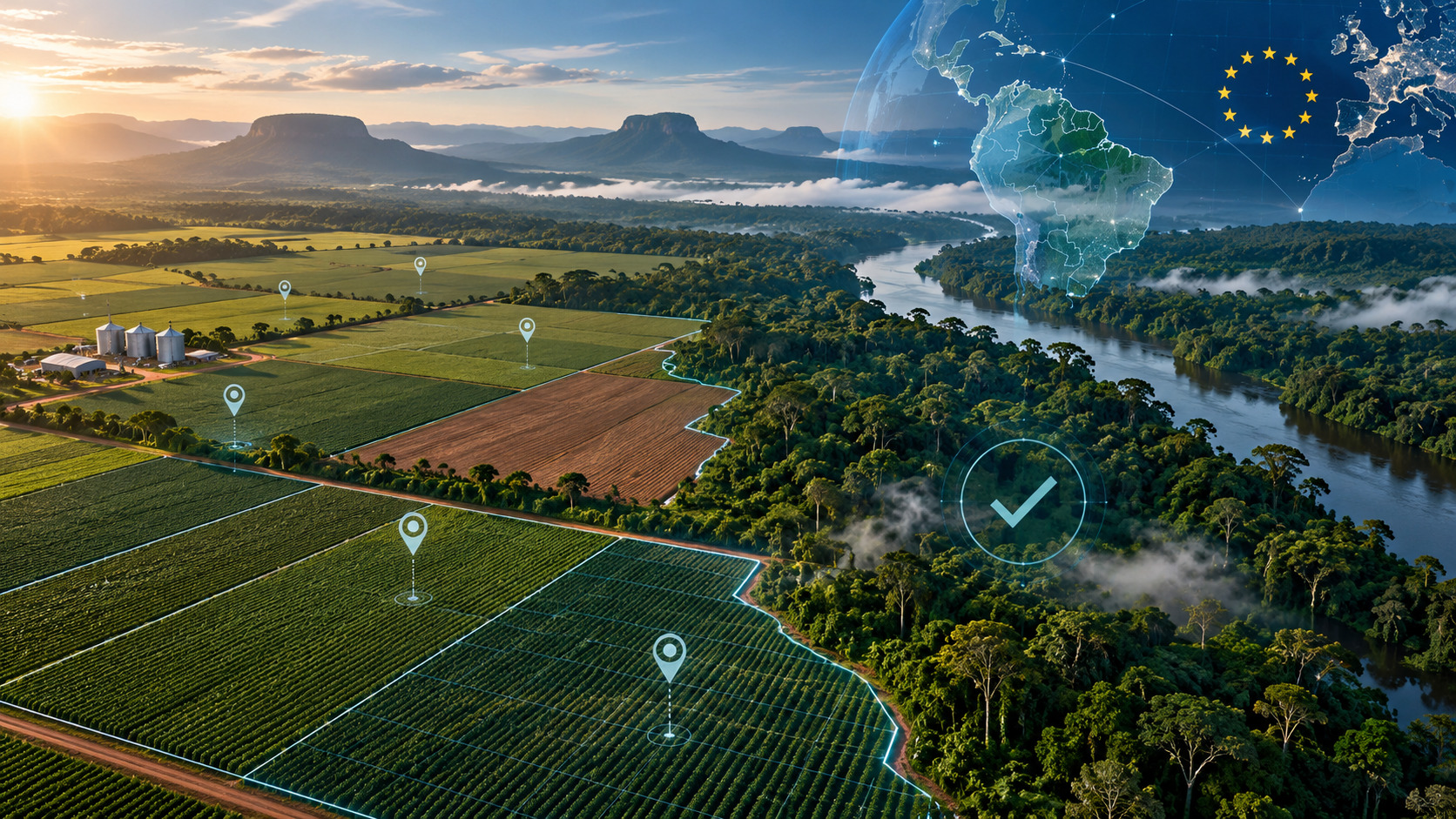
Trade between Latin America and the European Union is undergoing a structural transformation. At the centre of this shift is the EU Deforestation Regulation (EUDR), a framework that is redefining the rules for agricultural exports from the region.
What began as an environmental requirement has evolved into a technological and legal compliance challenge.
The new implementation timeline
Sustainability is no longer solely an environmental issue. It is becoming a condition for accessing international markets. The upcoming application of Regulation (EU) 2023/1115, known as the EUDR, is a clear example.
The Regulation aims to combat deforestation and forest degradation linked to the production of commodities and derived products entering the European Union.
Its impact on Latin America’s export basket is direct and significant. The Regulation prohibits the import of seven key commodities — and certain products derived from them — when they originate from land that was deforested or degraded after December 31, 2020.
The commodities covered are cattle, cocoa, coffee, oil palm, rubber, soy and wood.
Despite intense diplomatic negotiations aimed at preventing supply-chain disruptions and giving producers additional time to adapt, the Regulation — already postponed twice — is scheduled to apply from December 30, 2026 for large and medium-sized companies, while micro and small enterprises will be covered from June 30, 2027.
What does the EUDR require in terms of due diligence?
The Regulation requires operators placing these products on the European market for the first time to conduct a due diligence process capable of tracing them back to their origin.
This raises a central question: what does due diligence mean, and how should it be applied to comply with the Regulation?
In corporate compliance, due diligence is a systematic process of identifying, assessing and managing risks. It allows organisations to prevent non-compliance and document the measures adopted to mitigate those risks.
Under Regulation 2023/1115, due diligence is no longer merely a corporate best practice. It becomes a strict and binding legal obligation, requiring compliance with three core pillars: information gathering, risk assessment and risk mitigation where the identified risk cannot be considered negligible.
Within this process, the main substantive requirements include:
Geolocation and origin traceability: the production plot must be geographically identified through GPS coordinates or polygons, which must be provided as part of the compliance process.
Fixed cut-off date: operators must verify, including through tools such as satellite imagery, that the land was not deforested after December 31, 2020.
Compliance with local law: documentation must demonstrate compliance with the environmental, labour and land-use legislation applicable in the producing country.
Latin America’s current risk map
Compliance with these requirements also depends on the level of risk assigned to each country by the European Commission through a centralised benchmarking system, governed by Article 29 of the EUDR. Countries may be classified as low, standard or high risk.
Under this framework, almost all of Latin America has been classified as standard risk.
This group includes Argentina, Brazil, Colombia, Peru, Bolivia, Ecuador, Paraguay, Venezuela, Mexico, Guatemala, Honduras, El Salvador, Nicaragua, Panama and Belize.
As a result, countries within this category must apply the full due diligence process, including information collection, risk assessment and, where necessary, mitigation measures.
Chile, Uruguay and Costa Rica, among others, qualified for simplified due diligence, supported by their zero or very low deforestation rates and the strength of their regulatory frameworks.
The challenges ahead
The EUDR confirms that access to the European market no longer depends solely on product quality or price. It increasingly depends on the ability to demonstrate, through verifiable data, where goods come from and whether they were produced legally.
For Latin America, this creates a set of challenges extending far beyond environmental policy and into the technological, legal and economic spheres.
Ultimately, the European Union’s “green fence” can be viewed as a barrier, but also as an opportunity.
Countries and companies that anticipate the change, invest in traceability and turn regulatory compliance into a competitive advantage will not only be better positioned to preserve their access to the European market. They will also be better prepared for a broader global trend towards increasingly transparent and sustainable trade.